The chemistry of essential oils and artificial perfumes / by Ernest J. Parry.
- Parry, Ernest J. (Ernest John)
- Date:
- 1908
Licence: In copyright
Credit: The chemistry of essential oils and artificial perfumes / by Ernest J. Parry. Source: Wellcome Collection.
Provider: This material has been provided by UCL Library Services. The original may be consulted at UCL (University College London)
71/594 page 59
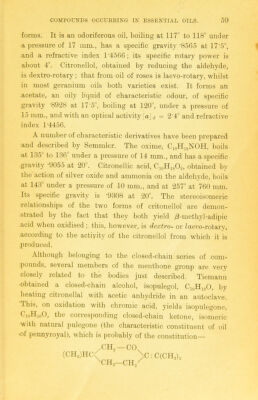
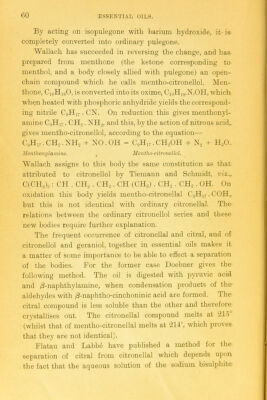
![iorms. It is an odoriferous oil, boiling at 117° to 118° under ;a pressure of 17 mm., has a specific gravity *8565 at 175°, :and a refractive index T4566; its specific rotary power is about 4°. Citronellol, obtained by reducing the aldehyde, is dextro-rotary; that from oil of roses is laevo-rotary, whilst in most geranium oils both varieties exist. It forms an acetate, an oily liquid of characteristic odour, of specific .gravity '8928 at 17-5°, boiling at 120°, under a pressure of 15 mm., and with an optical activity [a]d = 2'4° and refractive index 14456. A number of characteristic derivatives have been prepared :and described by Semmler. The oxime, Ci0H18NOH, boils at 135° to 136° under a pressure of 14 mm., and has a specific .gravity -9055 at 20°. Citronellic acid, C10H18O2, obtained by the'action of silver oxide and ammonia on the aldehyde, boils at 143° under a pressure of 10 mm., and at 257° at 760 mm. Its specific gravity is '9308 at 20°. The stereoisomers relationships of the two forms of critonellol are demon- strated by the fact that they both yield /3-methyl-adipic .acid when oxidised ; this, however, is dextro- or iaevo-rotary, .according to the activity of the citronellol from which it is .produced. Although belonging to the closed-chain series of com- .pounds, several members of the menthone group are very closely related to the bodies just described. Tiemann •obtained a closed-chain alcohol, isopulegol, Cl0H18O, by heating citronellal with acetic anhydride in an autoclave. This, on oxidation with chromic acid, yields isopulegone, C'i,,H10O, the corresponding closed-chain ketone, isomeric -with natural pulegone (the characteristic constituent of oil •of pennyroyal), which is probably of the constitution— (CH3)HC( >:C(CH3).,](https://iiif.wellcomecollection.org/image/b21687596_0071.jp2/full/800%2C/0/default.jpg)
 No text description is available for this image
 No text description is available for this image
 No text description is available for this image