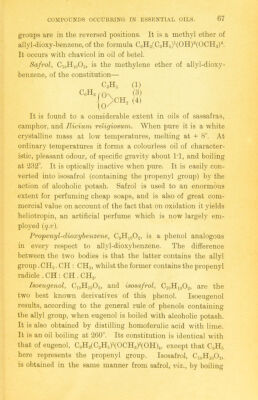
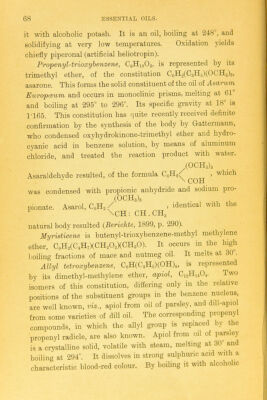
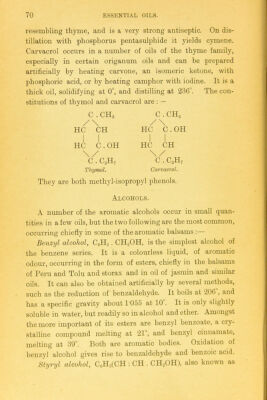
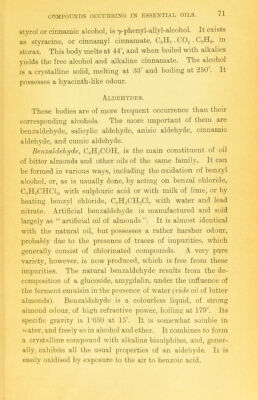
The chemistry of essential oils and artificial perfumes / by Ernest J. Parry.
- Parry, Ernest J. (Ernest John)
- Date:
- 1908
Licence: In copyright
Credit: The chemistry of essential oils and artificial perfumes / by Ernest J. Parry. Source: Wellcome Collection.
Provider: This material has been provided by UCL Library Services. The original may be consulted at UCL (University College London)
81/594 (page 69)
![potash the allyl group suffers rearrangement, and isoapiol, the isomeric methylene-dimethyl ether of propenyl-tetroxy- benzene, results. This is also a crystalline solid, forming leaflets melting at 56° and boiling at 304°. In 1896 Ciamician and Silber announced the discovery of an isomeric apiol, which they separated from the high boiling fractions of oil of dill. It is an oily liquid, boiling at 285° with slight decomposition. When boiled with alcoholic potash it yields isoapiol, which differs from it in containing the propenyl instead of the allyl group. This body melts at 44° and boils at 296° with slight decomposition. A close study of these bodies has made it clear that the two isomeric apiols possess the formulae— fOCH3 (5) (0,CH2 (5 and 4) J 02CH2 (4 and 3) ! OCH3 (3) C6Hl0CH3(2) C6H ]OCH3 (2) IC3H5 (1) 1C3H5 (1) Apiol. Isoapiol. where the numbers refer to the relative position of the radicles in the benzene nucleus. Here the C3H5 is the allyl group. The propenyl-apiols are of the same constitution, except that the C3H5 group represents the propenyl radicle in each case. Phenols with Ten Carbon Atoms. Methyl-propyl-phenol, C10H13OH.—Of the twenty possible isomeric forms of this phenol, only two are of common occurrence in essential oils. These are thymol and carvacrol. Thymol exists in various oils, notably in that of thyme. To obtain it in a fairly pure state, the oil can be shaken with a solution of caustic potash ; the aqueous layer, after separa- tion, is treated with excess of hydrochloric acid, which pre- cipitates the free phenol. It can also be prepared artificially from nitrocumic aldehyde. Thymol forms large, colourless crystals, melting at 44°, and boiling at 230°. It has an odour](https://iiif.wellcomecollection.org/image/b21687596_0081.jp2/full/800%2C/0/default.jpg)