The chemistry of essential oils and artificial perfumes / by Ernest J. Parry.
- Parry, Ernest J. (Ernest John)
- Date:
- 1908
Licence: In copyright
Credit: The chemistry of essential oils and artificial perfumes / by Ernest J. Parry. Source: Wellcome Collection.
Provider: This material has been provided by UCL Library Services. The original may be consulted at UCL (University College London)
97/594 (page 85)
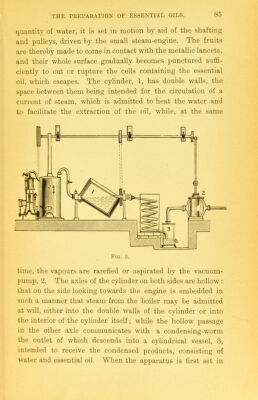
![quantity of water, it is set in motion by aid of the shafting and pulleys, driven by the small steam-engine. The fruits are thereby made to come in contact with the metallic lancets, and their whole surface gradually becomes punctured suffi- ciently to cut or rupture the cells containing the essential oil, which escapes. The cylinder, 1, has double walls, the space between them being intended for the circulation of a current of steam, which is admitted to heat the water and to facilitate the extraction of the oil, while, at the same flf tfflf h I* ii j! 1 1 ,1 i ' f If \ ] ,1 C HI ■ ■\ 5 | Hi 1 —^ r u i| i' 1 11 11 n i a T t =4 i } k,2 F)> i \t 1 m H 1, II [»■ \ Fig. 3. time, the vapours are rarefied or aspirated by the vacuum- pump, 2. The axles of the cylinder on both sides are hollow : that on the side looking towards the engine is embedded in such a manner that steam from the boiler may be admitted at will, either into the double walls of the cylinder or into the interior of the cylinder itself; while the hollow passage in the other axle communicates with a condensing-worm the outlet of which descends into a cylindrical vessel, 3, intended to receive the condensed products, consisting of water and essential oil. When the apparatus is first set in](https://iiif.wellcomecollection.org/image/b21687596_0097.jp2/full/800%2C/0/default.jpg)