Acute contagious diseases / By William M. Welch ... and Jay F. Schamberg ... Illustrated with 109 engravings and 61 full-page plates.
- Welch, William Miller, 1837-
- Date:
- 1905
Licence: Public Domain Mark
Credit: Acute contagious diseases / By William M. Welch ... and Jay F. Schamberg ... Illustrated with 109 engravings and 61 full-page plates. Source: Wellcome Collection.
Provider: This material has been provided by the Augustus C. Long Health Sciences Library at Columbia University and Columbia University Libraries/Information Services, through the Medical Heritage Library. The original may be consulted at the the Augustus C. Long Health Sciences Library at Columbia University and Columbia University.
31/802 page 35
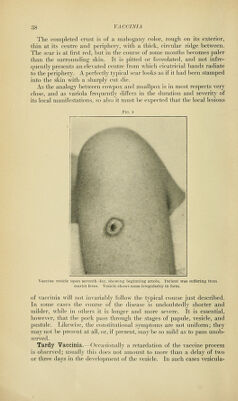
![8YMPT0MH AND <!<)ITIISI<: OF VAdafNIA ;{5 or an inch of licaltliy skin hciwccii the lesions, in lliis foiiiifry it is llic custom to make but a siii^'lc insertion. When a person has hccn ('X])os('(l jo tlic infection of snnillpox it is well to insert lym])li from two or three (iiU'erent tubes in (hiVerent phices, so that the fullest op|)ortunity of inducing vaccinia may he offered. It is better that the patient should suffer from a sore arm than from small- pox. SYMPTOMS AND COURSE OF VACCINIA. Vaccinia in the human subject is always produced by inoculation. While the evolution of the vaccine lesion is a more or less constant one, yet a certain degree of variation will result according; as the vaccination is performed with oi'iginal cowj)o\ virus, lono- humanized, or heifer- transmitted virus. These dift'erences refer rather to the comparative Iiilant born ola variolous mother in the .Municipal Hospital. Vaccinated ou day of birlh. Protection complete. Photographed on niiath day. rapidity of the process, the size of the lesion, and the character of the crust and the resulting scar, than to any deviation in the evolution of the pock. During the first two or three days after the insertion of the vaccine virus no symptoms are observed beyond those incident to the slight abrasion of the skin made by the operator's lancet. Ciw thp_third or fourth day very faint redness may be seen around the site of the inocula- tion. This redness gradually increases while at the same time a dis- tinct papule is formed, which becomes slightly more prominent by increasing in area rather than in height. On the fifth day the lesion begins to be vesicular. This is usually observed first upon the margin of the inoculated area. The vesicle gradually increases in size, and the l^miph that it contains is at first thin and perfectly transparent. On the eighth day the vesicle reaches its](https://iiif.wellcomecollection.org/image/b2120441x_0031.jp2/full/800%2C/0/default.jpg)




 No text description is available for this image
 No text description is available for this image
 No text description is available for this image