The soldier's pocket-book for field service / by General Viscount Wolseley.
- Garnet Wolseley, 1st Viscount Wolseley
- Date:
- 1886
Licence: Public Domain Mark
Credit: The soldier's pocket-book for field service / by General Viscount Wolseley. Source: Wellcome Collection.
88/590 page 70
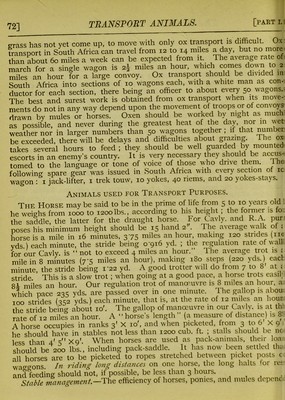
![72] srrass has not yet come up, to move with only ox transport is difficult. Ox transport in South Africa can travel from 12 to 14 miles a day, but no more than about 60 miles a week can be expected from it. The average rate of march for a single wagon is miles an hour, which comes down to 2 miles an hour for a large convoy. Ox transport should be divided in South Africa into sections of 10 wagons each, with a white man as con- ductor for each section, there being an officer to about every 50 wagons.- The best and surest work is obtained from ox transport when its move-' ments do not in any way depend upon the movement of troops or of convoys drawn by mules or horses. Oxen should be worked by night as much as possible, and never during the greatest heat of the day, nor in wet weather nor in larger numbers than 50 wagons together ; if that number be exceeded, there will be delays and difficulties about grazing. 1 he ox takes several hours to feed ; they should be well guarded by mounted escorts in an enemy's country. It is very necessary they should be accus- tomed to the language or tone of voice of those who drive them, the following spare gear was issued in South Africa with every section of ic wagon : 1 jack-lifter, 1 trek touw, 10 yokes, 40 riems, and 20 yokes-stays. Animals used for Transport Purposes. The Horse may be said to be in the prime of life from 5 to xo ^ears old he weighs from 1000 to 1200lbs., according to his height; the former is fo. the saddle, the latter for the draught horse. For Cavly. and R.A. pur' poses his minimum height should be 15 hand 2 . The average walk of • horse is a mile in 16 minutes, 375 miles an hour, making 120 strides (11c yds.) each minute, the stride being 0 916 yd. ; the regulation rate of walk for our Cavly. is “ not to exceed 4 miles an hour.” The average trot is ; mile in 8 minutes (7*5 miles an hour), making 180 steps (220 yds.) eacl minute, the stride being 122 yd. A good trotter will do from 7 to 8 at 1 stride This is a slow trot; when going at a good pace, a horse trots easil; gi miies an hour. Our regulation trot of manoeuvre is 8 miles an hour, a which pace 235 yds. are passed over in one minute. The gallop is abou 100 strides (352 yds.) each minute, that is, at the rate of 12 miles an hour, the stride being about 10'. The gallop of manoeuvre in our Cavly. is at th: rate of 12 miles an hour. A “ horse's length (a measure of distance) is 8'. A horse occupies in ranks 3' X 10', and when picketed, from 3 to 6 X 9 he should have in stables not less than 1200 cub. ft. ; stalls should be nc lie SI1UU1U 11CIYV. , 1 • 1 ■ less than 4' X9'. When horses are used as pack-animals, their loa should be 200 lbs., including pack-saddle. It has now been settled th; all horses are to be picketed to ropes stretched between picket posts c waggons In riding long distances on one horse, the long halts for res- and feeding should not, if possible, be less than 3 hours. Stable management. —The efficiency of horses, pomes, and mules depone](https://iiif.wellcomecollection.org/image/b28710332_0088.jp2/full/800%2C/0/default.jpg)


 No text description is available for this image
 No text description is available for this image
 No text description is available for this image