[Report of the Medical Officer of Health for London County Council 1957].
- London County Council (London, England). County of London.
- Date:
- 1958
Licence: Attribution-NonCommercial 4.0 International (CC BY-NC 4.0)
Credit: [Report of the Medical Officer of Health for London County Council 1957]. Source: Wellcome Collection.
120/227 page 108
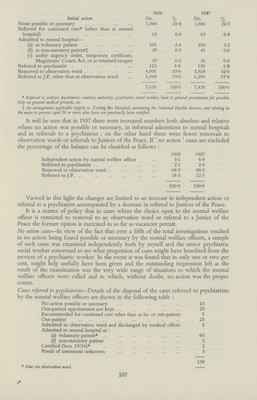
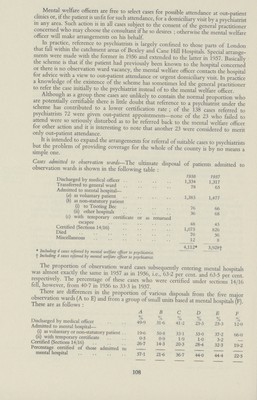
![108 Mental welfare officers are free to select cases for possible attendance at out-patient clinics or, if the patient is unfit for such attendance, for a domiciliary visit by a psychiatrist in any area. Such action is in all cases subject to the consent of the general practitioner concerned who may choose the consultant if he so desires ; otherwise the mental welfare officer will make arrangements on his behalf. In practice, reference to psychiatrists is largely confined to those parts of London that fall within the catchment areas of Bexley and Cane Hill Hospitals. Special arrange ments were made with the former in 1956 and extended to the latter in 1957. Basically the scheme is that if the patient had previously been known to the hospital concerned or there is no observation ward vacancy, the mental welfare officer contacts the hospital for advice with a view to out-patient attendance or urgent domiciliary visit. In practice a knowledge of the existence of the scheme has sometimes led the general practitioner to refer the case initially to the psychiatrist instead of to the mental welfare officer. Although as a group these cases are unlikely to contain the normal proportion who are potentially certifiable there is little doubt that reference to a psychiatrist under the scheme has contributed to a lower certification rate ; of the 138 cases referred to psychiatrists 72 were given out-patient appointments—none of the 23 who failed to attend were so seriously disturbed as to be referred back to the mental welfare officer for other action and it is interesting to note that another 23 were considered to merit only out-patient attendance. It is intended to expand the arrangements for referral of suitable cases to psychiatrists but the problem of providing coverage for the whole of the county is by no means a simple one. Cases admitted to observation wards—The ultimate disposal of patients admitted to observation wards is shown in the following table : 1956 1957[ /###] Discharged by medical officer 1,334 1,317 Transferred to general ward 78 65 Admitted to mental hospital- (a) as voluntary patient 1,383 1,477 (b) as non-statutory patient (i) to Tooting Bee 76 66 (ii) other hospitals 36 68 (c) with temporary certificate or as returned escapee 48 45 Certified (Sections 14/16) 1,075 826 Died 70 56 Miscellaneous 12 8 4,112* 3,928† * Including 4 cases referred by mental welfare officer to psychiatrist. † Including 4 cases referred by mental welfare officer to psychiatrist. The proportion of observation ward cases subsequently entering mental hospitals was almost exactly the same in 1957 as in 1956, i.e., 63.2 per cent. and 63.5 per cent. respectively. The percentage of these cases who were certified under sections 14/16 fell, however, from 40.7 in 1956 to 33.3 in 1957. There are differences in the proportion of various disposals from the five major observation wards (A to E) and from a group of small units based at mental hospitals (F). These are as follows : A % B % C % D % E % F % Discharged by medical officer 49.9 31.6 41.2 25.5 25.3 12.0 Admitted to mental hospital— (i) as voluntary or non-statutory patient . . 19.6 50.8 33.1 35.0 37.2 66.0 (ii) with temporary certificate 0.5 0.9 1.9 1.0 3.2 — Certified (Sections 14/16) 26.7 14.3 20.3 28.4 32.3 19.2 Percentage certified of those admitted to mental hospital 57.1 21.6 36.7 44.0 44.4 22.5](https://iiif.wellcomecollection.org/image/b18253015_0120.jp2/full/800%2C/0/default.jpg)
 No text description is available for this image
 No text description is available for this image
 No text description is available for this image