Tight-lacing, founded on physiology and phrenology, or, The evils inflicted on mind and body by compressing the organs of animal life, thereby retarding and enfeebling the vital functions / by O.S. Fowler.
- Orson S. Fowler
- Date:
- 1846
Licence: Public Domain Mark
Credit: Tight-lacing, founded on physiology and phrenology, or, The evils inflicted on mind and body by compressing the organs of animal life, thereby retarding and enfeebling the vital functions / by O.S. Fowler. Source: Wellcome Collection.
Provider: This material has been provided by the National Library of Medicine (U.S.), through the Medical Heritage Library. The original may be consulted at the National Library of Medicine (U.S.)
10/26
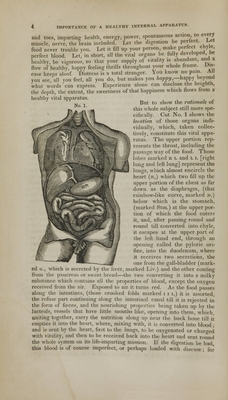
![and toes, imparting health, energy, power, spontaneous action to every muscle, nerve, the brain included. Let the digestion be periect. L,et food never trouble you. Let it fill up your person make periect chyle, perfect blood. Let, in short, all the vital organs be fully developed be healthy, be vigorous, so that your supply of vitality is abundant, and a flow of healthy, happy feeling thrills throughout your whole frame. .Dis- ease keeps aloof. Distress is a total stranger. You know no pain. AH you see, all you feel, all you do, but makes you happy— happy beyond what words can express. Experience alone can disclose the heigntn, the depth, the extent, the sweetness of that happiness which flows irorn a healthy vital apparatus. No. 1. But to show the rationale of this whole subject still more spe- cifically. Cut No. 1 shows the location of those organs indi- vidually, which, taken collec- tively, constitute this vital appa- ratus. The upper portion rep- resents the throat, including the passage way of the food. Those lobes marked r l and l l [right lung and left lung] represent the lungs, which almost encircle the heart (h,) which two fill up the upper portion of the chest as far down as the diaphragm, (that rainbow-like curve, marked d.) below which is the stomach, (marked Stm.) at the upper por- tion of which the food enters it, and, after passing round and round till converted into chyle, it escapes at the upper part of the left hand end, through an opening called the pyloric ori- fice, into the duodenum, where it receives two secretions, the one from the gall-bladder (mark- ed c, which is secreted by the liver, marked Liv.) and the other coming from the pancreas or sweet bread—the two converting it into a milky substance which contains all the properties of blood, except the oxygen received from the air. Exposed to air it turns red. As the food passes along the intestines, (those crooked folds marked i i i,) it is assorted, the refuse part continuing along the intestinal canal tili it is rejected in the form of feces, and the nourishing properties being taken up by the lacteals, vessels that have little mouths like, opening into them, which uniting together, carry the nutrition along up near the back bone till it empties it into the heart, where, mixing with, it is converted into blood; and is sent by the heart, first to the lungs, to be oxygenated or charged with vitality, and then to be received back into the heart and sent round the whole system on its life-imparting mission. If the digestion be bad this blood is of course imperfect, or perhaps loaded with disease ; for](https://iiif.wellcomecollection.org/image/b21120511_0010.jp2/full/800%2C/0/default.jpg)