Licence: In copyright
Credit: Photo-chemistry / by S.E. Sheppard. Source: Wellcome Collection.
54/484 page 38
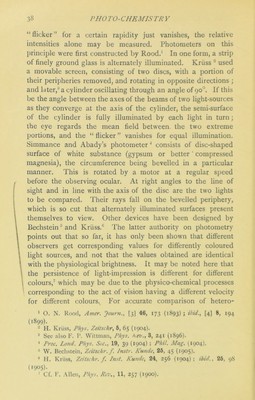
![“flicker” for a certain rapidity just vanishes, the relative intensities alone may be measured. Photometers on this principle were first constructed by Rood.1 In one form, a strip of finely ground glass is alternately illuminated. Kruss ' used a movable screen, consisting of two discs, with a portion of their peripheries removed, and rotating in opposite directions ; and later/ a cylinder oscillating through an angle of 90°. If this be the angle between the axes of the beams of two light-sources as they converge at the axis of the cylinder, the semi-surface of the cylinder is fully illuminated by each light in turn; the eye regards the mean field between, the two extreme portions, and the “ flicker ” vanishes for equal illumination. Simmance and Abady’s photometer1 consists of disc-shaped surface of white substance (gypsum or better ' compressed magnesia), the circumference being bevelled in a particular manner. This is rotated by a motor at a regular speed before the observing ocular. At right angles to the line of sight and in line with the axis of the disc are the two lights to be compared. Their rays fall on the bevelled periphery, which is so cut that alternately illuminated surfaces present themselves to view. Other devices have been designed by Bechstein5 and Kruss.The latter authority on photometry points out that so far, it has only been shown that different observers get corresponding values for differently coloured light sources, and not that the values obtained are identical with the physiological brightness. It may be noted here that the persistence of light-impression is different for different colours,7 which may be due to the physico-chemical processes corresponding to the act of vision having a different velocity for different colours. For accurate comparison of hetero- 1 O. N. Rood, Amer. Journ., [3] 46, 173 (1893) > ibid., [4] 8, 194 (1899). 2 H. Kruss, Phys. Zeitschr, 5, 65 (1904). 3 See also F. 1'. Wittman, Phys. Kev., 3, 241 (1896). * Proc. Loud. Phys. Soc., 19, 39 (1904) ; Phil. Mag. (1904). 5 W. Bechstein, Zeitschr. f. Instr. Kutide, 25, 45 (1905). u H. Kruss, Zeitschr. f. Inst. Kundc, 24, 256 (1904); ibid., 25, 98 (1905b](https://iiif.wellcomecollection.org/image/b28061445_0054.jp2/full/800%2C/0/default.jpg)
 No text description is available for this image
 No text description is available for this image
 No text description is available for this image