Licence: In copyright
Credit: Photo-chemistry / by S.E. Sheppard. Source: Wellcome Collection.
61/484 page 45
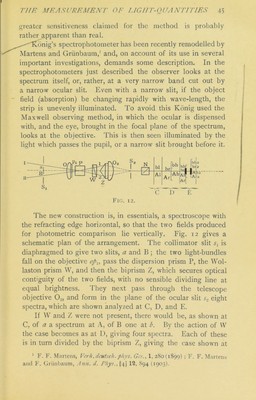
![greater sensitiveness claimed for the method is probably rather apparent than real. --'dvonig’s spectrophotometer has been recently remodelled by Martens and Griinbaum,1 and, on account of its use in several important investigations, demands some description. In the spectrophotometers just described the observer looks at the spectrum itself, or, rather, at a very narrow band cut out by a narrow ocular slit. Even with a narrow slit, if the object field (absorption) be changing rapidly with wave-length, the strip is unevenly illuminated. To avoid this Kbnig used the Maxwell observing method, in which the ocular is dispensed with, and the eye, brought in the focal plane of the spectrum, looks at the objective. This is then seen illuminated by the light which passes the pupil, or a narrow slit brought before it. The new construction is, in essentials, a spectroscope with the refracting edge horizontal, so that the two fields produced for photometric comparison lie vertically. Fig. 12 gives a schematic plan of the arrangement. The collimator slit .q is diaphragmed to give two slits, a and B; the two light-bundles fall on the objective opu pass the dispersion prism P, the Wol- laston prism W, and then the biprism Z, which secures optical contiguity of the two fields, with no sensible dividing line at equal brightness. They next pass through the telescope objective 02, and form in the plane of the ocular slit s.2 eight spectra, which are shown analyzed at C, D, and E. If W and Z were not present, there would be, as shown at C, of a a spectrum at A, of B one at b. By the action of W the case becomes as at D, giving four spectra. Each of these is in turn divided by the biprism Z, giving the case shown at 1 F. F. Martens, Ver/i.dcutsch.phvs. Gcs., 1, 280(1899) ; F. F. Martens and F. Griinbaum, Ann. d. Phys., [4] 12, S94 (1903).](https://iiif.wellcomecollection.org/image/b28061445_0061.jp2/full/800%2C/0/default.jpg)
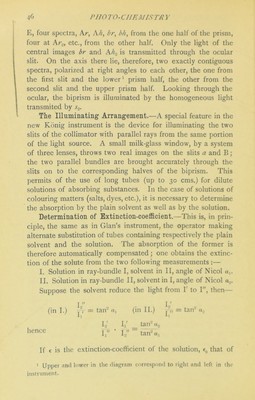

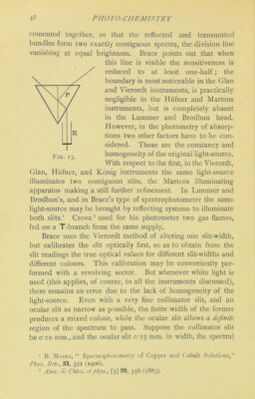
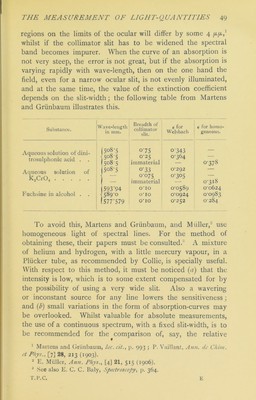
 No text description is available for this image
 No text description is available for this image
 No text description is available for this image