[Report 1947] / Medical Officer of Health, Ashford U.D.C.
- Ashford (Kent, England). Urban District Council.
- Date:
- 1947
Licence: Attribution 4.0 International (CC BY 4.0)
Credit: [Report 1947] / Medical Officer of Health, Ashford U.D.C. Source: Wellcome Collection.
26/30 (page 24)
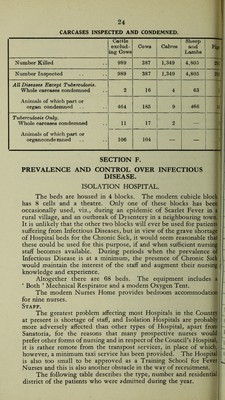
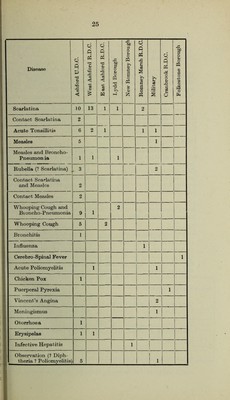
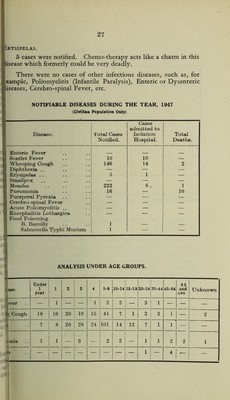
![CARCASES INSPECTED AND CONDEMNED. Cattle exclud- ing Cows Cows Calves Sheep and Lambs Piga Number Killed 989 387 1,349 4,805 . 292 j Number Inspected 989 387 1,349 4,805 292 All Diseases Except Tuberculosis. Whole carcases condemned 2 16 4 63 5 Animals of which part or organ condemned 464 185 9 466 ' 1| 181 Tuberculosis Only. Whole carcases condemned 11 17 2 — Animals of which part or organconde mned 106 104 — — 1 SECTION F. PREVALENCE AND CONTROL OVER INFECTIOUS DISEASE. ISOLATION HOSPITAL. The beds are housed in 4 blocks. The modern cubicle block has 8 cells and a theatre. Only one of these blocks has been i occasionally used, viz., during an epidemic of Scarlet Fever in a rural village, and an outbreak of Dysentery in a neighbouring town. I It is unlikely that the other two blocks will ever be used for patients ! suffering from Infectious Diseases, but in view of the grave shortage ; of Hospital beds for the Chronic Sick, it would seem reasonable that ! these could be used for this purpose, if and when sufficient nursing staff becomes available. During periods when the prevalence of Infectious Disease is at a minimum, the presence of Chronic Sick would maintain the interest of the staff and augment their nursing ' knowledge and experience. Altogether there are 68 beds. The equipment includes a ‘ Roth ’ Mechnical Respirator and a modern Oxygen Tent. The modern Nurses Home provides bedroom accommodation for nine nurses. Staff. The greatest problem affecting most Hospitals in the Country at present is shortage of staff, and Isolation Hospitals are probably more adversely affected than other types of Hospital, apart from Sanatoria, for the reasons that many prospective nurses would prefer other forms of nursing and in respect of the Council’s Hospital, it is rather remote from the transpost services, in place of which, however, a minimum taxi service has been provided. The Hospital is also too small to be approved as a Training School for Fever * Nurses and this is also another obstacle in the way of recruitment. The following table describes the type, number and residential district of the patients who were admitted during the year. J ( f I] 0](https://iiif.wellcomecollection.org/image/b28811392_0028.jp2/full/800%2C/0/default.jpg)