Medical diagnosis, with special reference to practical medicine : a guide to knowledge and discrimination of diseases / by J.M. DaCosta.
- Jacob Mendes Da Costa
- Date:
- 1870
Licence: Public Domain Mark
Credit: Medical diagnosis, with special reference to practical medicine : a guide to knowledge and discrimination of diseases / by J.M. DaCosta. Source: Wellcome Collection.
Provider: This material has been provided by The University of Leeds Library. The original may be consulted at The University of Leeds Library.
38/850 (page 36)
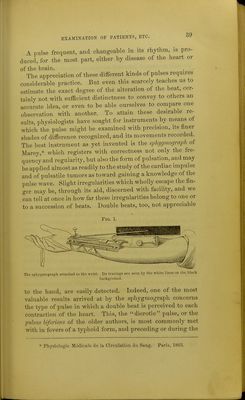
![MEDICAL DIAGNOSIS. the radial artery. The same may be said of the prognostic indications drawn from the pulse. It affords us in this re- spect much instruction; but any attempt to revive the various critical pulses, as taught by Solano or Bordeu, would be received with tbe same derision as we do tbe pretensions of our Chinese brethren to distinguish diseases by feeling the pulse of the right or the left side, or to determine, by its aid, the sex of the child in a pregnant woman. The pulse enlightens us on the action of the heart, and on something more—on the state of tbe artery itself and of the blood.^ In a healthy adult a beat of some resistance is felt, recurring from sixty-five to seventy-five times in a minute! It becomes slower with advancing years, though it may rise in the very aged. The pulse of infancy is one hundred and ten to one hundred and twenty; and of a child three years old, from ninety to ninety-five. Warmth quickens the pulse, so do rapid breathing, forced expiration, and the process of digestion. In the recumbent position and during sleep it falls. At the bedside we study in the pulse its frequency, its rhythm, its volume and strength, and its resistance. lncYQa.8Qdi frequency of the beat denotes increased frequency of the heart's action, and arises from any cause which excites the heart. Hence exercise, rapid breathing, mental emotion, or restlessness, will occasion the number of beats to exceed the average of health as readily as fievers or acute inflamma- tory diseases. In great debility, too, the pulse rises; and the more depressed the vital condition, the higher the ]3ulse becomes. The heart may thus quicken from so many and such varied causes acting temporarily or permanently, that increased frequency of pulse, taken by itself, has no signifi- cant diagnostic meaning. A slov) pulse, too, happens in many difl:erent states—from cold, exposure to wet, in icterus. It is also produced by an intense and prostrating shock, or is found coexisting with pressure on the brain. In some persons the pulse is naturally very slow. The rhythm of the pulse is often perverted. Instead of the beats following each other in regular succession, they](https://iiif.wellcomecollection.org/image/b2151012x_0038.jp2/full/800%2C/0/default.jpg)