Researches on the arseniates, phosphates, and modifications of phosphoric acid / by Thomas Graham.
- Thomas Graham
- Date:
- 1904
Licence: In copyright
Credit: Researches on the arseniates, phosphates, and modifications of phosphoric acid / by Thomas Graham. Source: Wellcome Collection.
Provider: This material has been provided by UCL Library Services. The original may be consulted at UCL (University College London)
33/56 page 29
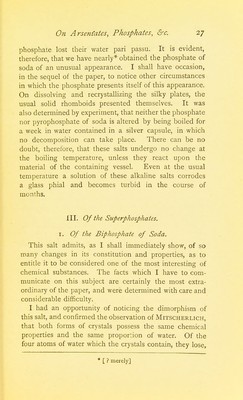
![The crystals of Diphosphate of potash contain only the two essential atoms of water, and the lustre of their surfaces is not affected by a water-bath heat, nor by any degree of heat under 4000 Fahr. A solution of either of these alkaline biphosphates, when added to nitrate of silver, occasions a copious pre- cipitation of the yellow subphosphate of silver; and if ammonia be cautiously added, so as merely to make up * the excess of nitric acid disengaged, the whole phos- phoric acid falls in that state. It is to be here remarked, that the three atoms base of the alkaline biphosphate are replaced in this precipitation by three atoms of oxide of silver. 2. Second variety of Biphosphate of Soda, or Bipyro- phosphate of Soda. When a quantity of the biphosphate of soda, pre- viously dried on the water-bath, is afterwards gradually heated on a solder-bath, it begins to lose water at about 3750, and before it is raised to 400° it has lost exactly half the water which it possessed, or one atom. The dried salt may thereafter be heated up to 45o°, and maintained for an hour or more at that temperature, without sustaining any further loss. When rapidly heated in a glass tube, the salt undergoes semifusion at some point near 4000, and the same quantity of water comes off in a state of ebullition. 1 St. Thus 2.62 grains of the salt dried on the water- bath, when heated in a thin glass tube, lost at once 0.2 grain water on attaining 4000, which is one half of the water which it possessed, namely, 0.396 grain; while it was exposed again for four hours to a temperature between 450° and 4700, without losing 0.01 grain addi- tional. * [ ? take up. (See p. 31, line 4)].](https://iiif.wellcomecollection.org/image/b21687687_0033.jp2/full/800%2C/0/default.jpg)


 No text description is available for this image
 No text description is available for this image
 No text description is available for this image