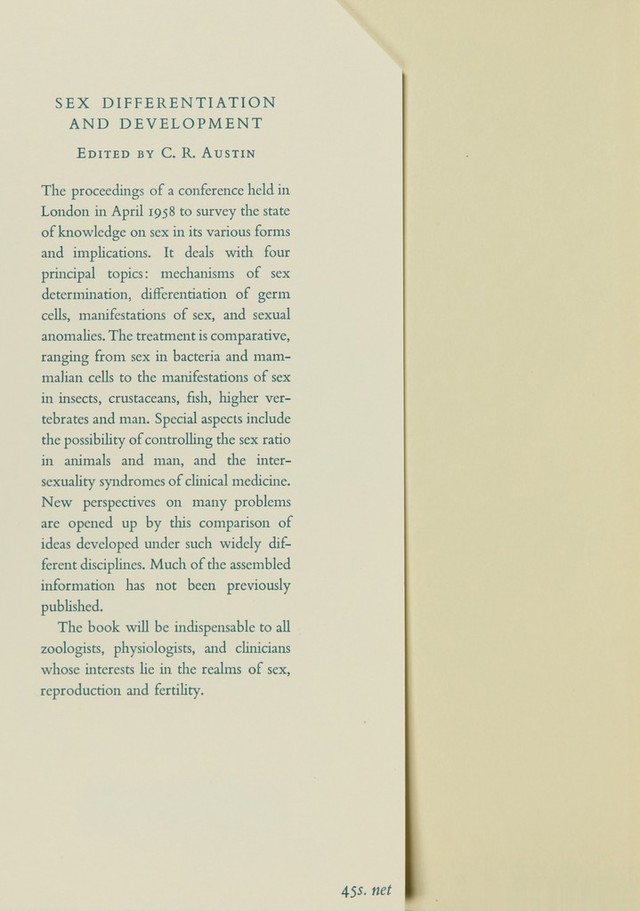
Sex differentiation and development : proceedings of a symposium held at the Royal Scoiety of Medicine, Wimpole Street, London, on 10 and 11 April 1958 / edited on behalf of the Society for Endocrinology by C.R. Austin.
- Symposium on Sex Differentiation and Development (1958 : London, England)
- Date:
- 1960
Licence: Attribution-NonCommercial-NoDerivatives 4.0 International (CC BY-NC-ND 4.0)
Credit: Sex differentiation and development : proceedings of a symposium held at the Royal Scoiety of Medicine, Wimpole Street, London, on 10 and 11 April 1958 / edited on behalf of the Society for Endocrinology by C.R. Austin. Source: Wellcome Collection.
18/230 page 4
![4 с. G. BUTLER thirty-two in the female; and Ris & Kerr [unpublished observations quoted by Ruttner & Mackensen, 1952] have shown that Manning's sex chromosome does not stain with Feulgen, although it does so with haematoxylin, and they have, therefore, concluded that it is a nucleolus and not a sex chromosome at all. Some further evidence against Manning's scheme is provided by the gynandromorph honeybees studied by Rothenbuhler,Gowen & Park [1951], who claim to have, shown that the male tissue of these gynandromorphs was produced by the entry into the ovum of supernumerary sperm. Since, on Manning's hypothesis, maleness is due to a sex chromosome, which is not contained in the sperm, and the effect of the autosomes in the sperm is to make the egg female, supernumerary sperms could only make the zygote still more female. The other theory of sex determination in the honeybee has been put forward by Mackensen [1951]. Its theoretical mechanism resembles that shown by Whiting [1940, 1943] to exist in Habrobracon. Mackensen suggests that in the honeybee a series of sex alleles exist that give female characteristics when heterozygous and are lethal in the homozygous conditions, a viable male only being produced from the unfertilized haploid egg. His evidence in favour of this theory lies in the rapidity with which, on close inbreeding, the viability of the eggs laid diminishes towards 50%. Whilst, in our own bee breeding at Rothamsted, Some reduction in viability has been observed on close inbreeding, we have at present inadequate data on which to decide for or against Mackensen's theory. The ability of worker honeybees to rear both queens and workers from fertilized eggs has long formed the basis of practical queen rearing by beekeepers, and there is no possible reason to suppose that differentiation of the queen and worker castes is determined genetically, as it has been shown to be in some of the so-called stingless bees of the genus Melipona [Kerr, 1946]. Caste determination in the honeybee is determined in the feeding of the female larvae concerned. It has been shown experimentally that it is essential for differential feeding to begin before the larva is 3 days old if a perfect queen is to result, although queens with a number of worker-like characteristics can be produced from older larvae. Two principal theories to explain caste determination have been put forward. In the first, it is suggested that the quality of the food received by a larva acts as the determining factor, and in the second, that it is the quantity of the food received that matters. According to the qualitative theory, differences occur in the brood food (which consists partly of a secretion, rich in protein, of the pharyngeal glands of the worker bees) fed to the larvae of queens and workers after the first 24 hr or so of larval life [von Rhein, 1933]. But analyses that have been carried out by various workers give very contradictory results, and this has led Haydak [1943] and others to conclude that brood food varies in composition quite fortuitously, and that such variations as occur cannot be responsible for caste determination. Having decided that the quality of the food was unlikely to be the responsible factor in caste determination, Haydak considered that it must be attributable to differences in](https://iiif.wellcomecollection.org/image/b18024117_0019.JP2/full/800%2C/0/default.jpg)


 No text description is available for this image
 No text description is available for this image
 No text description is available for this image