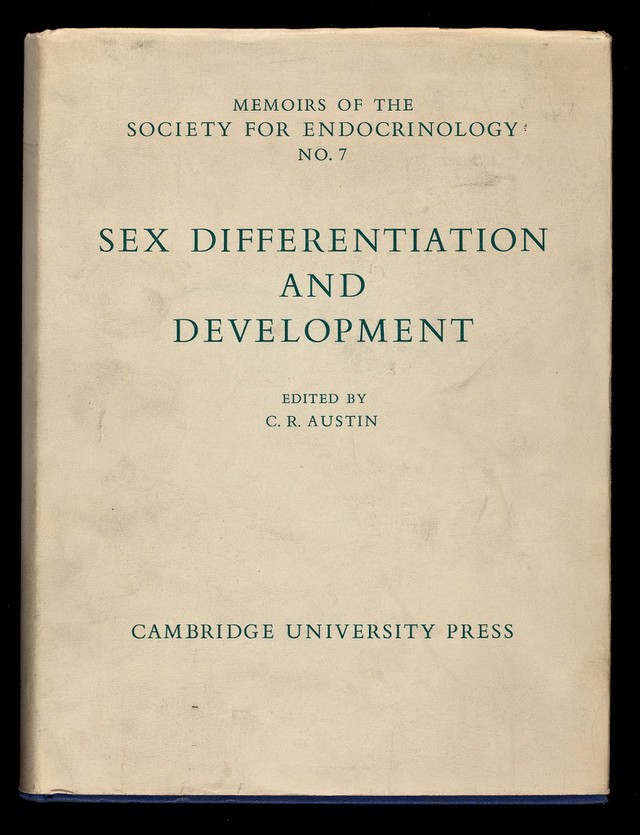
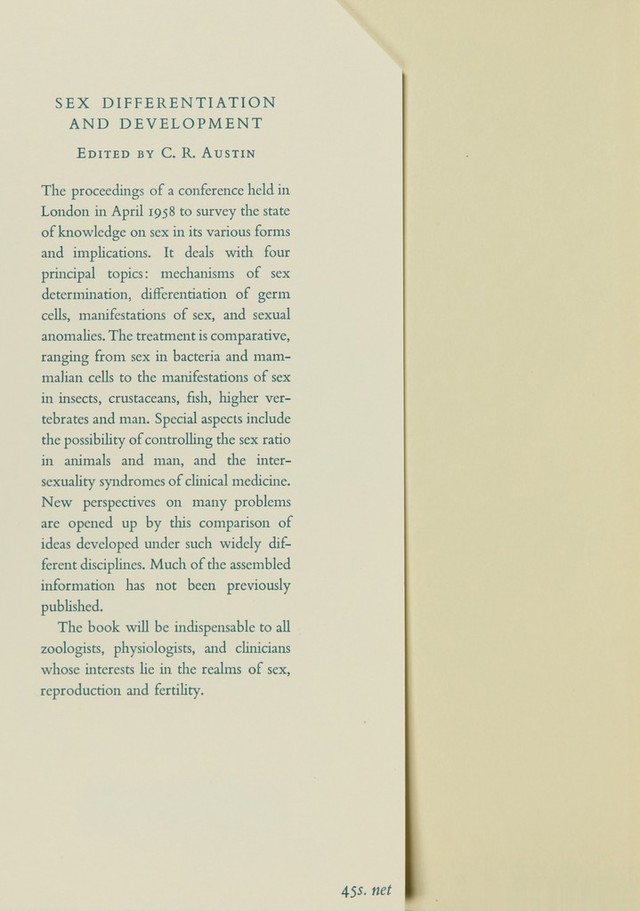
Sex differentiation and development : proceedings of a symposium held at the Royal Scoiety of Medicine, Wimpole Street, London, on 10 and 11 April 1958 / edited on behalf of the Society for Endocrinology by C.R. Austin.
- Symposium on Sex Differentiation and Development (1958 : London, England)
- Date:
- 1960
Licence: Attribution-NonCommercial-NoDerivatives 4.0 International (CC BY-NC-ND 4.0)
Credit: Sex differentiation and development : proceedings of a symposium held at the Royal Scoiety of Medicine, Wimpole Street, London, on 10 and 11 April 1958 / edited on behalf of the Society for Endocrinology by C.R. Austin. Source: Wellcome Collection.
22/230 page 8
![8 с. G. BUTLER COMMENT Peacock: I should like to draw your attention to certain long-standing problems of sex in invertebrates. For example, how far the theories of sex determination in the two hymenopterans, the honeybee and Hahrohracon, discussed by Dr Butler, can be applied to other arrhenotokously parthenogenetic organisms, e.g. saw-flies, ants and other Hymenoptera, rotifers, thrips, remains imknown. Regarding sex determination in other insects, two particular cases in the Lepidoptera are of interest. Goldschmidt [Bibl. genet., Lpz., 1934, ii, i] obtained intersexes of the gypsy moth by crossing different geographical races which differed in the strength of their female- and male-determining factors. More recently, Seiler [Experientia, 1949, 5, 425] obtained different results with Solenobia moths. For example, a tetraploid female of a parthenogenetic race, crossed with a male of a diploid race, gave triploid intersexes. Goldschmidt held that all members of a given hybrid brood showed the same degree of intersexuality and that the degree of intersexuality was finally attained only after the competing female- and male-producing determining factors had reacted over a certain period of time. In contrast, Seiler found all grades of intersexes in the same brood, and no switch-over of sex during the larval and later stages, each individual intersex beginning and remaining at the same fixed grade. Seiler therefore suggests that there operate phenotypic factors at present unknown. In certain Crustacea, other than the decapods to be dealt with by Dr Carlisle, as well as in other invertebrates, we find alternation between the parthenogenetic and bisexual modes of reproduction (heterogony). Environmental factors certainly determine this alternation. By refined culture techniques, in which the effects of food, light, tempera¬ ture, excretory products, etc., were tested, von Dehn [Zool.Jb. 1937, 58, 241; Natur¬ wissenschaften, 1950, 37, 429] and Büchner [Z. indukt. Abstamm. VererbLehre, 1936, 'jz, 141], respectively for the crustaceans Daphnia and Moina and certain rotifers, found that the females of a long-continued parthenogenetic culture can be switched to male production, the main factor involved being the quaHty of food, the fatstuff content of the latter being important in Moina. Also effective to a certain extent in Moina were light deficiency associated with food deficiency, and darkness. In the gall-midge Oligarces paradoxus, the larva of which is parthenogenetic (paedogenesis), the switch¬ over to adulthood and bisexuality is effected by the quantity of food, or more strictly, by the constellation of environmental factors (age of parent, population density, etc.) that together influence the food available [Ulrich, Naturwissenschaften, 1940, 36, 569; 37, 586]. In the bean aphis, where a succession of parthenogenetic generations occurs on alternate host-plants, Davidson [Ann. appi. Biol. 1929, 16, 104] showed that, after prolonged parthenogenetic reproduction, sexual females and males could be produced by reducing the amount of light or by lowering the temperature. No hereditary factors deterrnining sex have so far been observed by von Dehn, Bucbner nor Ulrich in their experimental material. How the environmental factors mentioned produce their effects of sex change or change in the method of reproduction, by influencing chromosomal and/or endocrine processes, is unknown.](https://iiif.wellcomecollection.org/image/b18024117_0023.JP2/full/800%2C/0/default.jpg)


 No text description is available for this image
 No text description is available for this image
 No text description is available for this image