Monasticon Anglicanum: a history of the abbies and other monasteries, hospitals, frieries, and cathedral and collegiate churches, with their dependencies, in England and Wales; also of all such Scotch, Irish and French monasteries, as were in manner connected with religious houses in England / Originally pub. in Latin by Sir William Dugdale...[Now ed., enriched with a large accession of materials taken from leiger books, chartularies, rolls, and other documents preserved in the national archives, public libraries, and other repositories; the history of each religious foundation in English being prefixed to its respective series of Latin charters. By John Caley...Henry Ellis...and the Rev. Bulkeley Bandinel.
- William Dugdale
- Date:
- 1846
Licence: Public Domain Mark
Credit: Monasticon Anglicanum: a history of the abbies and other monasteries, hospitals, frieries, and cathedral and collegiate churches, with their dependencies, in England and Wales; also of all such Scotch, Irish and French monasteries, as were in manner connected with religious houses in England / Originally pub. in Latin by Sir William Dugdale...[Now ed., enriched with a large accession of materials taken from leiger books, chartularies, rolls, and other documents preserved in the national archives, public libraries, and other repositories; the history of each religious foundation in English being prefixed to its respective series of Latin charters. By John Caley...Henry Ellis...and the Rev. Bulkeley Bandinel. Source: Wellcome Collection.
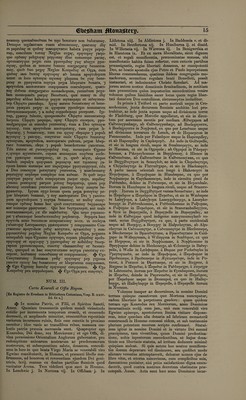
![The following description of the Seal of the abbey of Evesham is communicated by Edward Rudge, Esq. F. R. S. & A. S. the proprietor of the manor, site, and demesne lands of the monastery, and is taken from an impression in wax now in his possession affixed to a lease of the manor house and demesne lands of Middle Little¬ ton, granted by the last abbat, Phillip Hawford, to John Aldington, Dec. 16, 30th Hen. VIII. The principal side of the Seal gives a representation of the legend which relates to the building of the abbey- church and to the endowment of the abbey by King Ethelred.a Round the extremity of the principal side of this Seal are the words, sigillvm . sancte . marie . et . SANCTI ECGWINI . EPI . EOVESHAMENSIS . MONASTERII . “ The Seal of St. Mary and of St. Egwin bishop of the monas¬ tery of Evesham.” Beneath the representation of the abbey church, at the upper part of the Seal, are the words, ecce . loc . que . elegi. i. e. Ecce locum quern elegi: “ Behold the place which I have chosen.” The lower inscription, round Eoves attending his swine, has been carefully compared with two other im¬ pressions of the abbey Seal taken from a different matrix, also in Mr. Rudge’s possession ; and the following expla¬ nation of it will be found to correspond with the subject represented within it. EOVES HER . WENEDE . MIT . WAS . SWIN ECGWIN . CLEPET . VIS EOVISHOM. “ Eoves here wended with his swine Ecgwin named [it] Vic Eovishom.” Which old English rhimes, for such they are intended to be, may be thus explained : 1. Eoves, the name of the Swineherd. 2. Her, Saxon for here. 3. Wenede, the old English or Saxon word wended, i. e. went. 4. Mit, a corruption of wit, the Saxon with; the w turned upside down. 5. Was, probably a corruption of his ; which, as well as the preceding word, may have been incorrectly copied from an impression of an earlier Seal, which was perhaps lost. 6. Swin, swine. The next line is much less difficult of explanation, when duly considered and compared with the legendary story. 7. Ecgwin. The first letter appears to want the middle stroke; the second letter is a c, and not an o. 8. Clepet, named. 9. Vis eovishom. On the original Seal the third letter was most likely a c instead of s, which will ex¬ plain this word to be the Eoveshom of the Wiccians, or people of Worcestershire, who were originally called Vicci, or Wicci. The spot, as the legend suggests, had originally been simply called Hom, i. e. holm. Eg¬ win, therefore, when he built the abbey at the instance of Eoves’s vision, gave a new name to the place. The vie was afterwards omitted when the county got another name, and Vic Eoveshom became Evesham. Or the vis may be intended for the Saxon vie, a village, or place surrounded by a winding river, which is the precise situation of the town of Evesham, encompassed as it is by the Avon forming a horse-shoe around it. On the reverse of this Seal, on the left and near the top, the Virgin is seated, with the child on her lap, within a Gothic niche. On the right side, near the top, is St. Egwin kneeling, and holding up with both hands a representation of the abbey-church, which appears to be another side of the same church given in the im¬ pression on the obverse. Beneath St. Egwin, is a bi¬ shop, receiving from a king a charter, on which is inscribed damus regie libertati. Under the char¬ ter, on an oval shield, are the royal arms, the three leopards of England. Behind the bishop is a monk, bare-headed, holding up his right hand; in his left is a book. Behind the king is the figure of a queen seated, and beyond her an attendant also seated, holding a falcon on his arm. All these figures are under canopies of the early Gothic form. The inscription round, is in a si¬ milar character to that on the other side, and entirely in the Latin language : a few of the letters at the bottom are broken off, on which account the inscription cannot be completely made out: dictis . ecgwini . dan . . . . FRATRI RI . OMNIBUS . UNDE . PIE . NITET . AULA. SACRAE . MARIE. Penwortham and Alceter, cells to Evesham, will be spoken of in their respective places. Cartac ai> Chcsljamcmit Contohtum tn agro aUtgomtmst sptttantcs. NUM. I. [W. Malmesb. fol. 162 a, n. 10.] Habet etiam Wigornensis provincia abbatiam Eveshamensem, et Perscorensem. Eveshamum fundavit beatus Egwinus episcopus, de quo quid miraculi sit, quod Beda tacuerit, nondum per me potui advertere, vel per alios addiscere, prsesertim quod cum Kenredo rege Merciorum et Offa rege Orientalium Anglorum Romam iverit, quorum profectionem historicus non siluit. Ve- rumtamen quaecunque res hanc taciturnitatem impera- verit, constat eum tertium Wigorniensium prsesulem fuisse, locum ilium quo nunc coenobium visitur, pecu- liariter amasse, incultum antea et spinetis horridum, sed ecclesiolam ab antiquo habentem, ex opere forsitan Brittannorum. Eo loci vir sanctissimus, dum solitudine invitante frequentaret excubias, Dei genitricis visione et alloquutione mulceri meruit, plane et absque scrupulo prsecipientis, ut ibidem sibi fundaret coenobium futurum sibi gratiosum, illi negotiosum. Institit ille jussis et complens opus, apostolicis et regiis privilegiis corrobo- ravit. Quid illud? credendumne putatur, quod tradit antiquitas? peccatorum juvenilium quondam conscium, pedes compedibus irretiisse, clavibus compedum in am- nem jactatis, palam dixisse, tunc se demum de peccatis securum futurum, ciim compedes vel divinitus, vel ipsis reserarentur- clavibus; ita Romam profectum prospere- que reversum. Jam vero in illo mari, quo a Gallico continenti Angliam navigio transmittitur, cum naviga- ret, immanem piscem saltu puppim, qua pontifex vehe- batur, ingressum, certatimque annitentibus nautia reten- TOL. II. * See Num. I. E](https://iiif.wellcomecollection.org/image/b30455832_0001_0031.jp2/full/800%2C/0/default.jpg)