Report of the State board of health of Massachusetts on water-supply and sewerage : under the provisions of chapter 274, of the acts of 1886.
- Massachusetts Department of Public Health
- Date:
- 1888
Licence: Public Domain Mark
Credit: Report of the State board of health of Massachusetts on water-supply and sewerage : under the provisions of chapter 274, of the acts of 1886. Source: Wellcome Collection.
Provider: This material has been provided by the Augustus C. Long Health Sciences Library at Columbia University and Columbia University Libraries/Information Services, through the Medical Heritage Library. The original may be consulted at the the Augustus C. Long Health Sciences Library at Columbia University and Columbia University.
69/118 page 53
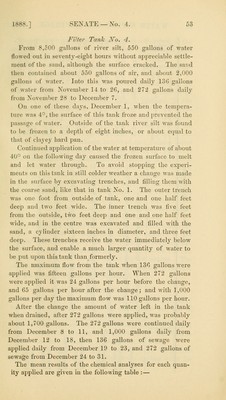
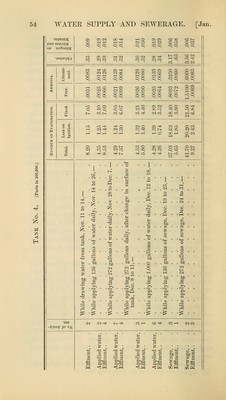
![FVter Tank Ro. 4. From 8,500 gallons of river silt, 550 gallons of water flowed out in seventy-eight hours without appreciable settle- ment of the sand, although the surface cracked. The sand then contained about 550 gallons of air, and about 2,000 gallons of water. Into this was poured daily 136 gallons of water from November 14 to 26, and 272 gallons daily from November 28 to December 7. On one of these days, December 1, when the tempera- ture was 4*^, the surface of this tank froze and prevented the passage of water. Outside of the tank river silt was found to be frozen to a depth of eight inches, or about equal to that of clayey hard pan. Continued application of the water at temperature of about 40^^ on the following day caused the frozen surface to melt and let water through. To avoid stopping the experi- ments on this tank in still colder weather a change was made in the surface by excavating trenches, and filling them with the coarse sand, like that in tank No. 1. The outer trench was one foot from outside of tank, one and one half feet deep and two feet wide. The inner trench was five feet from the outside, tVvo feet deep and one and one half feet wide, and in the centre was excavated and filled with the sand, a cylinder sixteen inches in diameter, and three feet deep. These trenches receive the water immediately below the surface, and enable a much larger quantity of water to be put upon this tank than formerly. The maximum flow from the tank when 13G gallons were applied was fifteen gallons per hour. When 272 gallons were applied it was 24 gallons per hour before the change, and Qb gallons per hour after the change ; and with ] ,000 gallons per day the maximum flow was 110 gallons per hour. After the change the amount of water left in the tank when drained, after 272 gallons were applied, was probably about 1,700 gallons. The 272 gallons were continued daily from December 8 to 11, and 1,000 gallons daily from December 12 to 18, then 136 gallons of sewage were applied daily from December 19 to 23, and 272 gallons of sewage from December 24 to 31. The mean results of the chemical analyses for each quau- ity applied are given in the following table :—](https://iiif.wellcomecollection.org/image/b21230298_0069.jp2/full/800%2C/0/default.jpg)
 No text description is available for this image
 No text description is available for this image
 No text description is available for this image