The Christian philosopher, or, the connection of science and philosophy with religion / [Thomas Dick].
- Thomas Dick
- Date:
- 1835
Licence: Public Domain Mark
Credit: The Christian philosopher, or, the connection of science and philosophy with religion / [Thomas Dick]. Source: Wellcome Collection.
18/362 page 14
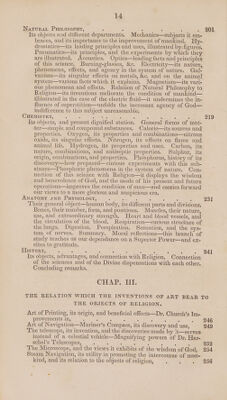
![Natura. Puiiosopuy, : : ; ; 3 ; Its objects and different departments. Mechanics—subjects it em- braces, and its importance to the improvement of mankind. Hy- drostatics—its leading principles and uses, illustrated by-figures. Pneumatics—its principles, and the experiments by which they are illustrated. Acoustics. Optics—leading facts and principles of this science. Burning-glasses, &c. Electricity—its nature, phenomena, effects, and agency in the system of nature. Gal- vanism—its singular effects on metals, &c. and on the animal System—various facts which it explains. Magnetism—its vari- ous phenomena and effects. Relation of Natural Philosophy to Religion—its inventions meliorate the condition of mankind— illustrated in the case of the electric fluid—it undermines the in- fluence of superstition—untolds the incessant agency of God— indifference to this subject unreasonable. CHEMISTRY, : 5 oes 5 4 , : : 2 Its objects, and present dignified station. General forms of mat- ‘ter—simple and compound substances. Caloric—its sources and properties. Oxygen, its properties and combinations—nitrous oxide, its singular effects. Nitrogen, its effects on flame and animal life. Hydrogen, its properties and uses. Carbon, its nature, combinations, and antiseptic properties. Sulphur, its origin, combinations, and properties. Phosphorus, history of its discovery—how prepared—curious experiments with this sub- stance—Phosphoric phenomena in the system of nature. Con- nection of this science with Religion—it displays the wisdom and benevolence of God, and the mode of his present and future operations—improves the condition of man—and carries forward our views to a more glorious and auspicious era. ANATOMY AND PuysioLoey, : See et : : : : Their general object—human body, its different parts and divisions. Bones, their number, form, and positions. Muscles, their nature, use, and extraordinary strength. Heart and blood vessels, and the circulation of the blood. Respiration—curious structure of the lungs. Digestion. Perspiration. Sensation, and the sys- tem of nerves. Summary. Moral reflections—this branch of study teaches us our dependance on a Superior Power—and ex- cites to gratitude. History, : : ; aan : A : : : . 241 Its objects, advantages, and connection with Religion. Connection of the sciences and of the Divine dispensations with each other. Concluding remarks. ; 201 219 - 231 CHAP. III. THE RELATION WHICH THE INVENTIONS OF ART BEAR TO THE OBJECTS OF RELIGION. Art of Printing, its origin, and beneficial effects—Dr. Church’s Im- provements in, 4 : ; : i : : - 246 Art of Navigation—Mariner’s Compass, its discovery and use, 249 The telescope, its invention, and the discoveries made by it—serves instead of a celestial vehicle—Magnifying powers of Dr. Her- schel’s ‘Telescopes, : : : : : : , : 252 The Microscope, and the views it exhibits of the wisdom of God, 254. Steam Navigation, its utility in promoting the intercourse of man- kind, and its relation to the objects of religion, ‘ Se ees bis 1] 3](https://iiif.wellcomecollection.org/image/b3328684x_0018.jp2/full/800%2C/0/default.jpg)