A dissertation on the origin and progress of the Scythians or Goths. Being an introduction to the ancient and modern history of Europe / By John Pinkerton.
- John Pinkerton
- Date:
- 1787
Licence: Public Domain Mark
Credit: A dissertation on the origin and progress of the Scythians or Goths. Being an introduction to the ancient and modern history of Europe / By John Pinkerton. Source: Wellcome Collection.
236/246 page 206
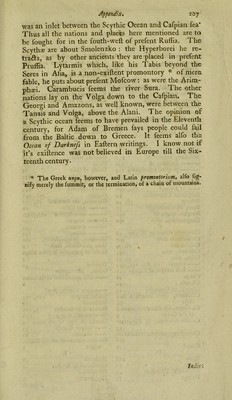
![plus of Ohter and Wulfftan. The Hirri gave name to Jrland, or F'trland in Icdandig accounts* now Reval. Scir 'tngpcdl, or the ruk or town of the Scirrt, fcems to have been prefent Kronftadt, oppofite Petcrburg The gulf Cylipenus is apparently that of J* inland; Lagnus another name for the fouth of the Baltic or Codanus. Pliny having various authors before him was confounded with various names for thefame fubjefl. Cartris is IFend-jyJjel on the north of Jutland, a pcnin- fula fo called from fVend [om Ktnt ox Cant) a point or head-land- Burchana is Funen, or Zeeland, lies of the Suiones. Pliny’s Divifions of Germans are not unexception- able. The Vandili were by his owm account Ingaevones, as above Ihewn. Of them the Varini were quite on the Weft, next the Angli, as perfedly known from Tacitus, and the Leges Wnrinorum ct Anglorum ftill. extant, and publiftied by Leibnitz. The other three were all together, quite on the eaft. So that Pliny’s accuracy is not great. The Cimbri, Teutoni, Chauci, were all on the w'eftern ocean ; yet Pliny had placed the Ingaevones on the eaft ! I he Iftaevones were really next the Rhine ; but Tacitus found no Cimbri Mediterranei there. The other two diviftons are right. But Tacitus is the author to be depended on, as to Germany : Pliny’s dcfcription is however valuable. The Second Extraft from lib. VI. c. 14- rather con- cerns the north of Europe than of Alia. 1 he Tanais or Don was the ancient, as the modern, boundary of Alia and Europe. But on the north moderns have ex- tended it to the Uralian Mountains, along the river Oby ; while the ancients brought it much farther weft, following the Tanais, which runs fouth-eaft. The eaft; end of the Gulf of Finland was of courle the ancient boundary between Alia and Europe. Here then Pliny begins and goes to the eaft, along the ftiores of a non- exiftent ocean, the Scythic, till he comes to the river Volga ; which, with many of the ancients, he thought ■* Mr. Fordcr, in Barrington’s Orofius, followed alfo by ]\Tr. B. in his Mifccllanics, errs lo grofsly as to take Oluer’s Irland foi Scotland I Irland was on Ohtcr’s right hand, not on leaving Nor- way, but as he approached Sciringfheal. There are no ilcs on the fouth of Scotland ; the iles between Irland and ‘ this land’ aie thofe ofOefel.&c. The fta fouth of Sciringlhcal isthe Finnini gulf, to which Gotland is oppolice, as Ohter lays. But compare the paflage ; and fee Firland m the maps to Snorro, Havniar, 1777, cS;c. was](https://iiif.wellcomecollection.org/image/b28754529_0236.jp2/full/800%2C/0/default.jpg)




 No text description is available for this image
 No text description is available for this image
 No text description is available for this image