The interpretation of dreams / by Sigmund Freud ; authorized tr. of 3rd ed. with introduction, by A. A. Brill.
- Sigmund Freud
- Date:
- 1913
Licence: Public Domain Mark
Credit: The interpretation of dreams / by Sigmund Freud ; authorized tr. of 3rd ed. with introduction, by A. A. Brill. Source: Wellcome Collection.
Provider: This material has been provided by the Francis A. Countway Library of Medicine, through the Medical Heritage Library. The original may be consulted at the Francis A. Countway Library of Medicine, Harvard Medical School.
66/534 page 48
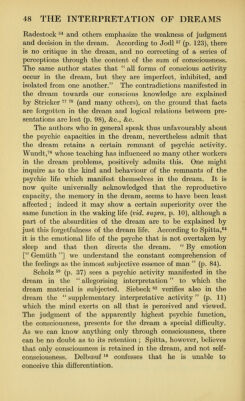
![Radestock 54 and others emphasize the weakness of judgment and decision in the dream. According to Jodl37 (p. 123), there is no critique in the dream, and no correcting of a series of perceptions through the content of the sum of consciousness. The same author states that all forms of conscious activity occur in the dream, but they are imperfect, inhibited, and isolated from one another. The contradictions manifested in the dream towards our conscious knowledge are explained by Strieker 77 78 (and many others), on the ground that facts are forgotten in the dream and logical relations between pre- sentations are lost (p. 98), &c, &c. The authors who in general speak thus unfavourably about the psychic capacities in the dream, nevertheless admit that the dream retains a certain remnant of psychic activity. Wundt,76 whose teaching has influenced so many other workers in the dream problems, positively admits this. One might inquire as to the kind and behaviour of the remnants of the psychic life which manifest themselves in the dream. It is now quite universally acknowledged that the reproductive capacity, the memory in the dream, seems to have been least affected ; indeed it may show a certain superiority over the same function in the waking life (vid. supra, p. 10), although a part of the absurdities of the dream are to be explained by just this forgetfulness of the dream life. According to Spitta,64 it is the emotional life of the psyche that is not overtaken by sleep and that then directs the dream. By emotion [ Gemiith ] we understand the constant comprehension of the feelings as the inmost subjective essence of man (p. 84). Scholz 59 (p. 37) sees a psychic activity manifested in the dream in the allegorising interpretation to which the dream material is subjected. Siebeck 62 verifies also in the dream the supplementary interpretative activity (p. 11) which the mind exerts on all that is perceived and viewed. The judgment of the apparently highest psychic function, the consciousness, presents for the dream a special difficulty. As we can know anything only through consciousness, there can be no doubt as to its retention ; Spitta, however, believes that only consciousness is retained in the dream, and not self- consciousness. Delbceuf16 confesses that he is unable to conceive this differentiation.](https://iiif.wellcomecollection.org/image/b21173965_0066.jp2/full/800%2C/0/default.jpg)