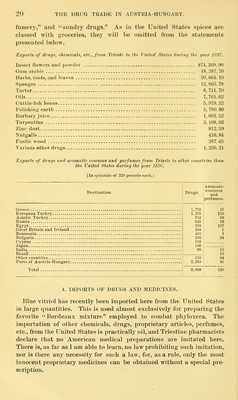
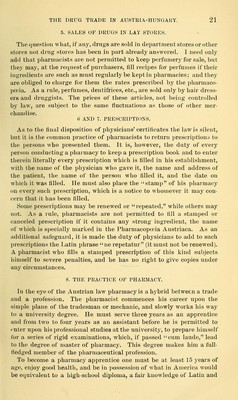
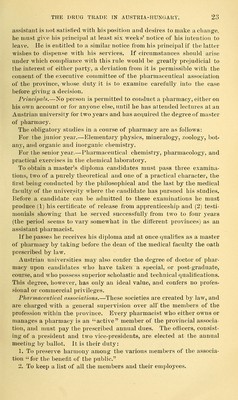
The drug trade in foreign countries : vol. XIV : reports from the consuls of the United States upon the laws and regulations governing : 1. the drug business : 2. druggists v. pharmacists : 3. exports of drugs and chemicals : 4. imports of drugs and medicines : 5. sale of drugs and medicines in lay stores : 6. disposal of prescriptions : 7. renewal of prescriptions : 8. practice of pharmacy / issued from the Bureau of Foreign Commerce, Department of State.
- United States. Bureau of Foreign Commerce
- Date:
- 1898
Licence: Public Domain Mark
Credit: The drug trade in foreign countries : vol. XIV : reports from the consuls of the United States upon the laws and regulations governing : 1. the drug business : 2. druggists v. pharmacists : 3. exports of drugs and chemicals : 4. imports of drugs and medicines : 5. sale of drugs and medicines in lay stores : 6. disposal of prescriptions : 7. renewal of prescriptions : 8. practice of pharmacy / issued from the Bureau of Foreign Commerce, Department of State. Source: Wellcome Collection.
Provider: This material has been provided by the Francis A. Countway Library of Medicine, through the Medical Heritage Library. The original may be consulted at the Francis A. Countway Library of Medicine, Harvard Medical School.
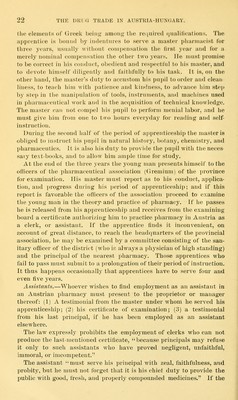
![the eleinciits of (Jreek hciiij^' umoii;;'the reiiiiiied (|iialilications. The apprentice is Itoimd l»y indentiiies to serve a master pharmacist for three years, usually without (toinpeusation tlie first year and for a merely iioiuinal compensation the otlier two years, lie must promise to be correct in his conduct, obedient and respectful to his master, and to devote himself diligently and faithfully to his task. It is, on the other hand, the master's duty to accustom his pupil to order and clean liness, to teach him with patience and kindness, to advance him ste]» by step in the manipulation of tools, instruments, and machines used in pharnjaeeutical woik and in the acquisition of technical knowledge. The master can not compel his pupil to ])erform menial labor, and he must give hinj from one to two hours everyday for reading and self- instruction. During tlie second half of the period of a]>prenticeship the master is obliged to instruct liis pui)il in natural history, botany, chemistry, and pharmaceutics. It is also his duty to i)rovi(le the pupil with the neces- sary text-books, and to allow him ample time for study. At the end of the three years the young man presents himself to the officers of the pharmaceutical association (Gremium) of the province for examination. His master must report as to his conduct, applica- tion, and progress during his period of apprenticeship; and if this report is favorable the officers of the association proceed to examine the young man in the theory and practice of pharmacy. If he passes he is released from his apprenticeship and receives from the examining board a certificate authorizing him to practice i)harmacy in Austria as a clerk, or assistant. If the apprentice finds it inconvenient, on account of great distance, to reach the headquarters of the provincial association, he may be examined by a committee consisting of the san- itary officer of the district (who is always a physician of high standing) and the principal of the nearest pharmacy. Those apprentices who fail to x)ass must submit to a prolongation of their period of instruction. It thus haj)pens occasionally that ai^prentices have to serve four and even five years. Assistants.—Whoever wishes to find employment as an assistant in an Austrian pharmacy must present to the proprietor or manager thereof: (1) A testimonial from the master under whom he served his apprenticeship; (2) his certificate of examination; (3) a testimonial from his last principal, if he has been employed as an assistant elsewhere. The law expressly prohibits the employment of clerks who can not produce the last-mentioned certificate, because principals may refuse it only to such assistants who have proved negligent, unfaithful, immoral, or imcompetent, The assistant must serve his principal with zeal, faithfulness, and probity, but he must not forget that it is his chief duty to provide the public with good, fresh, and properly compounded medicines. If the](https://iiif.wellcomecollection.org/image/b21070313_0028.jp2/full/800%2C/0/default.jpg)