The drug trade in foreign countries : vol. XIV : reports from the consuls of the United States upon the laws and regulations governing : 1. the drug business : 2. druggists v. pharmacists : 3. exports of drugs and chemicals : 4. imports of drugs and medicines : 5. sale of drugs and medicines in lay stores : 6. disposal of prescriptions : 7. renewal of prescriptions : 8. practice of pharmacy / issued from the Bureau of Foreign Commerce, Department of State.
- United States. Bureau of Foreign Commerce
- Date:
- 1898
Licence: Public Domain Mark
Credit: The drug trade in foreign countries : vol. XIV : reports from the consuls of the United States upon the laws and regulations governing : 1. the drug business : 2. druggists v. pharmacists : 3. exports of drugs and chemicals : 4. imports of drugs and medicines : 5. sale of drugs and medicines in lay stores : 6. disposal of prescriptions : 7. renewal of prescriptions : 8. practice of pharmacy / issued from the Bureau of Foreign Commerce, Department of State. Source: Wellcome Collection.
Provider: This material has been provided by the Francis A. Countway Library of Medicine, through the Medical Heritage Library. The original may be consulted at the Francis A. Countway Library of Medicine, Harvard Medical School.
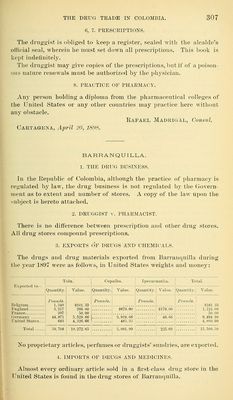
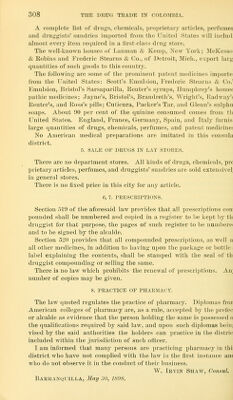
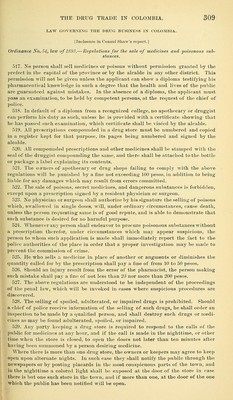
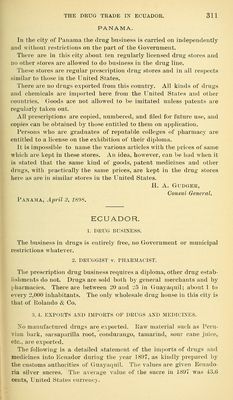
![LAW GOVERNING THE DRUG BUSINESS IN COLOMBIA. [Inclosure in Consul Sliaw's rejiort.] Ordinance No. 54, law of 1893.—Regulations for the sale of medicijies and lioisonous sub- stances. 517. N© person sball sell medicines or poisons without permission granted by the prefect in the capital of the province or by the alcalde in any other district. This permission will not be given unless the applicant can show a diploma testifying his pharmaceutical knowledge in such a degree that the health and lives of the i)ublic are guaranteed against mistakes. In the absence of a diploma, the applicant must pass an examination, to be held by competent persons, at the request of the chief of police. 518. In default of a diploma from a recognized college, no apothecary or druggist can-perform his duty as such, unless he is provided with a certificate showing that he has passed such examination, which certificate shall be visaed by the alcalde. 519. All prescriptions compounded in a drug store must be numbered and copied in a register kept for that purpose, its pages being numbered and signed by the alcalde. 520. All compounded prescriptions and other medicines shall be stamped with the seal of the druggist compounding the same, and there shall be attached to the bottle or package a label explaining its contents. 521. The ovvners of apothecary or drug sho^js failing to comply with the above regulations will be punished by a fine not exceeding 100 pesos, in addition to being liable for any damages which may result from errors committed. 522. The sale of poisons, secret medicines, and dangerous substances is forbidden, except upon a prescription signed by a resident physician or surgeon. 523. No physician or surgeon shall authorize by his signature the selling of poisons which, swallowed in single doses, will, under ordinary circumstances, cause death, unless the person requesting same is of good repute, and is able to demonstrate that such substance is desired for no harmful purpose. 524. Whenever any person shall endeavor to procure poisonous substances without a prescription therefor, under circumstances which may appear suspicious, the person to whom such application is made shall immediately report the fact to the police authorities of the place in order that a proper investigation may be made to prevent the commission of crime. 525. He who sells a medicine in place of another or augments or diminishes the quantity called for by the prescription shall pay a fine of from 10 to 50 pesos. 526. Should an injury result from the error of the pharmacist, the person making such mistake shall pay a fine of not less than 20 nor more than 200 pesos. 527. The above regulations are understood to be independent of the proceedings of the penal law, which will be invoked in cases where suspicious procedures are discovered. 528. The selling of spoiled, adulterated, or impaired drugs is prohibited. Should a chief of police receive information of the selling of such drugs, he shall order an inspection to be made by a qualified person, and shall destroy such drugs or medi- cines as may be found adulterated, spoiled, or impaired. 529. Any party keeping a drug store is required to respond to the calls of the public for medicines at any hour, and if the call is made in the nighttime, or other time when the store is closed, to open the doors not later than ten minutes after having been summoned by a person desiring medicine. Where there is more than one drug store, the owners or keepers may agree to keep open upon alternate nights. In such case they shall notify the public through the newspapers or by posting placards in the most conspicuous parts of the town, and in the nighttime a colored light shall be exposed at the door of the store in case there is but one such store in the town, and if more than one, at the door of the one which the public has been notified will be open.](https://iiif.wellcomecollection.org/image/b21070313_0315.jp2/full/800%2C/0/default.jpg)
 No text description is available for this image
 No text description is available for this image
 No text description is available for this image