The drug trade in foreign countries : vol. XIV : reports from the consuls of the United States upon the laws and regulations governing : 1. the drug business : 2. druggists v. pharmacists : 3. exports of drugs and chemicals : 4. imports of drugs and medicines : 5. sale of drugs and medicines in lay stores : 6. disposal of prescriptions : 7. renewal of prescriptions : 8. practice of pharmacy / issued from the Bureau of Foreign Commerce, Department of State.
- United States. Bureau of Foreign Commerce
- Date:
- 1898
Licence: Public Domain Mark
Credit: The drug trade in foreign countries : vol. XIV : reports from the consuls of the United States upon the laws and regulations governing : 1. the drug business : 2. druggists v. pharmacists : 3. exports of drugs and chemicals : 4. imports of drugs and medicines : 5. sale of drugs and medicines in lay stores : 6. disposal of prescriptions : 7. renewal of prescriptions : 8. practice of pharmacy / issued from the Bureau of Foreign Commerce, Department of State. Source: Wellcome Collection.
Provider: This material has been provided by the Francis A. Countway Library of Medicine, through the Medical Heritage Library. The original may be consulted at the Francis A. Countway Library of Medicine, Harvard Medical School.
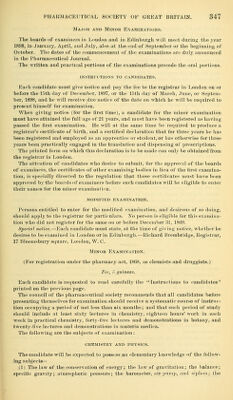
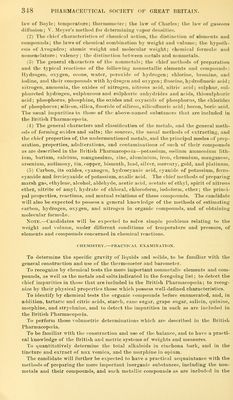
![law of lioylo; touipciatiire; theriuoiiiclor; the law of CliiirleH; tho law of f^aHCons (lltliiHion; V. Meyer's methoil foi' df^terniiuing vapor densities. (2) Tho cliiff chiiracteristicH of chemical action, tlie (listiiictiou of elements and compounds; tho laws of chenucal combination l)y weight and volume;; tho hyi)otli- csis of Avogadro; atomic weij^ht and molecular weight; (chemical fonnuLc and nomenclature: valency; the distinction lietween metals and nonmetals. (!)) The general chiiiactcrs of the nonmetals; the chief methods f)f preparation and thi^ typical reactions of the following nonmetallic elements and compoiin(l>: Hydrogen, oxygen, ozone, water, ])croxid(^ of hydrogen; chlorine, lnoniine, and iodine, ancl their conipcjunds with hydrogen and oxygen; fluorine, hydrofluoric aci<l; nitrogen, ammonia, the oxides of nitrogen, nitrous acid, nitric acid; sulphur, siil- phureted hydrogen, sulphurous and sulphuric anhydrides and acids, thiosulphuric acid; phosphorus, phospliine, the oxides and oxyacids of phosphorus, the chlorides of phosphorus; silicon, silica, fluoride of silicon, silicofluoric acid; boron, horic acid. The usual impurities in those of the above-named substances that are included in the British Pharmacopn-ia. (4) The general characters and classitication of the metals, and the general meth- ods of forming oxides and salts; the sources, the usual methods of extracting, and the chief properties of, the undermentioned metals, and the principal modes of ])rep- aration, properties, adulterations, and contaminations of such of their compounds as are described in the British Pharmacopceia—potassium, sodium ammonium lith- ium, barium, calcium, manguesium, zinc, alnmininm, iron, chromium, manganese, arseuium, antimony, tin, copper, bismuth, lead, silver, juercury, gold, and platinum. (5) Carbon, its oxides, cyanogen, hydrocyanic acid, cyanide of potassium, ferro- cyanide and fenicyauide of potassium, oxalic acid. The chief methods of preparing marsh gas, ethylene, alcohol, aldehyde, acetic acid, acetate of ethyl, spirit of nitrous ether, nitrite of amyl, hydrate of chloral, chloroform, iodoform, ether; the princi- pal properties, reactions, and mutual relations of these compounds. The candidate will also be expected to possess a general knowledge of the methods of estimating carbon, hydrogen, oxygen, and nitrogen in organic compounds, and of obtaining molecular formuhe. Note.—Candidates will he expected to solve simple problems relating to the weight and volume, under diftereut conditions of temperature and pressure, of elements and compounds concerned in chemical reactions. CHEMISTRY.—PRACTICAL EXAMINATION. To determine the specific gravity of liquids and solids, to be familiar with the general construction and use of the thermometer and barometer. To recognize by chemical tests the more important nonmetalic elements and com- pounds, as well as the metals and salts indicated in the foregoing list; to detect the chief impurities in those that are included in the British Pharmacopceia; to recog- nize by their physical properties those which possess well-defined characteristics. To identify by chemical tests the organic compounds before enumerated, and, in aiUlition, tartaric and citric acids, starch, cane sugar, grape sugar, salicin, quinine, morphine, and strychnine, and to detect the impurities in such as are included in the British Pharmacopoeia. To perform those Aolumetric determinations which are described in the British Pharmacopceia. To be familiar with the construction and use of the balance, and to have a practi- cal knowledge of the British and metric systems of weights and measures. To ciuantitatively determine the total alkaloids in cinchona bark, and in the tincture and extract of nux vomica, and the morphine in opium. The candidate will further be expected to have a practical acquaintance with the methods of preparing the more important inorganic substances, including the non- metals and their compounds, and such metallic compounds as are included in the](https://iiif.wellcomecollection.org/image/b21070313_0354.jp2/full/800%2C/0/default.jpg)

 No text description is available for this image
 No text description is available for this image
 No text description is available for this image