Medical testimony in regard to Dr. Davis's new mode of treating joint diseases.
- Henry Gassett Davis
- Date:
- [1863?]
Licence: Public Domain Mark
Credit: Medical testimony in regard to Dr. Davis's new mode of treating joint diseases. Source: Wellcome Collection.
Provider: This material has been provided by the National Library of Medicine (U.S.), through the Medical Heritage Library. The original may be consulted at the National Library of Medicine (U.S.)
9/22
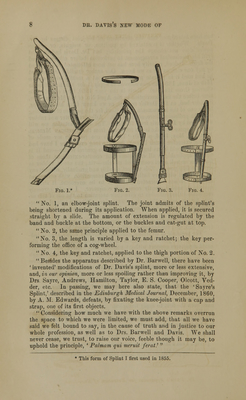
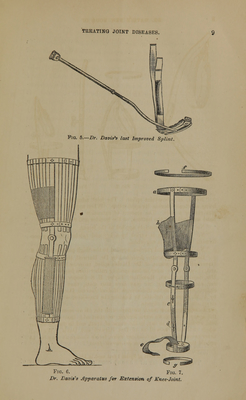
![has been introduced into the treatment of hip-joint disease by Dr. Davis. Whether it is attained by position, or weights, or spring- power, does not change the principle; but Dr. Davis had brought even his mechanical arrangement to perfection before others entered the field. Indeed, priority here has not been attempted to be proved by any one else, as far as we know. Our author candidly tells us that he had used it in private practice for about a month, when, on the 14 th of June, 1860, he was allowed to apply it for the first time in Charing Cross Hospital. Early in the year 1860, for a considerable time before the full description in the April No. of the Monthly, Dr. Scudder had, at Dr. Davis's request, as we know from his own lips, taken one of the instruments to England, for the purpose of exhibiting it to the profession there, and in Paris. Adhesive plaster and rubber were used by Dr. Davis from the first. The only quotation we will take the space to make is the following, from the American Medical Monthly, May, 1856, p. 330: 'There is one point in my mode of making extension which I think, from the long experience I have had in its use, would be an improvement on the general modes—and it is equally applicable in all extensions and counter-extensions, those of fractures as well as of contracted muscles—viz., the use of rubber as an extending power. This will act steadily and gradually, without any violence, and with very little suffering in comparison with permanent fixtures. When contracted muscle is to be overcome, it steadily wearies it, until it silently comes off conqueror. I would earnestly recommend the profession to give their attention to the use of this ar- ticle for the accomplishment of extension. What is termed a door- spring is one good form; another, for lighter purposes, is the shirred rubber.' The correspondence of this language with that used by our author (page 326, and the bottom of 267,) is quite remarkable. The priuciple of treatment, concisely expressed, consists but in 'ab- traction1 of the joint by continued-elastic-extension, securing to the dis- eased structures support without pressure, and motion without fric- tion. Both of the latter requirements must be satisfied; and though they were equally insisted on by Dr. Davis years ago, already some of the professed improvements on his splint evince the ignorance in this regard (especially as far as refers to motion of the joiut) of some prominent members of the profession, even at this day. After Dr. Davis's invention was made, the adaptation of the apparatus to other joints than those he happened to employ it in, hardly entitles a man to any credit; as to the wrist and elbow-joint, we believe ourselves to have been the first to apply the splint. We should like to have reproduced here the engravings of the ' Davis Splint,' that we have employed long before any other splint had been brought forward.* [* Figs. 1 and 2 have previously appeared in the Monthly. We are not cer- tain that these are the illustrations our reviewer refers to, circumstances render- ing his seeing proof-sheets of this article impracticable.—Ed.]](https://iiif.wellcomecollection.org/image/b2111383x_0009.jp2/full/800%2C/0/default.jpg)