The student's handbook of surgical operations.
- Sir Frederick Treves, 1st Baronet
- Date:
- 1892
Licence: Public Domain Mark
Credit: The student's handbook of surgical operations. Source: Wellcome Collection.
Provider: This material has been provided by the Gerstein Science Information Centre at the University of Toronto, through the Medical Heritage Library. The original may be consulted at the Gerstein Science Information Centre, University of Toronto.
34/530 page 14
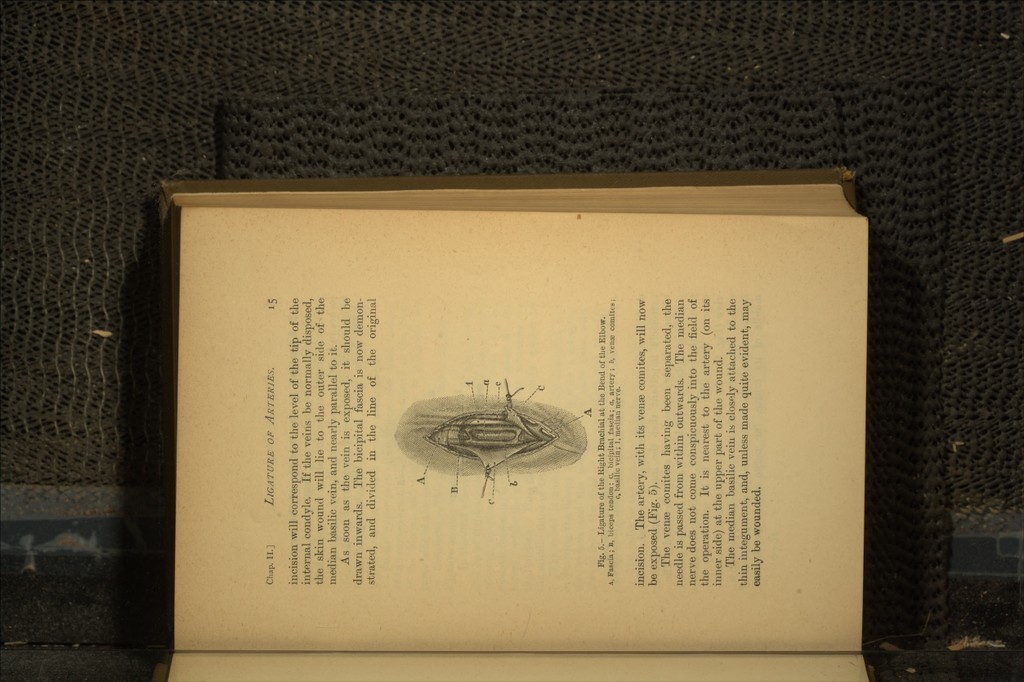
![THE BRACHIAL ARTERY. Line of the artery.—When the arm is extended and abducted with the hand supine, the brachial artery corresponds to a line drawn from the outlet of the axilla (at the junction of its middle and anterior thirds) to the middle of the bend of the elbow. Position.—In securing the artery at the bend of the elbow, the limb, extended and abducted, may be allowed to rest upon the olecranon. It should not be over-extended. In dealing with the vessel in the arm, the limb should be extended and abducted with the hand supine, and should be held away from the body. The arm itself should not be supported in any way, but the limb should be held by the fore-arm by an assistant. The surgeon may make the incision from above downwards on both sides of the body, standing to the outer side of the limb on the right side, and between the trunk and the limb on the left side. Or on the left side the operator may place himself to the outer side of the limb, and, bending over it, may make the incision from below upwards. ]. Ligature at the bend of the elbow. Operation.—The arm having been placed in the position indicated, the surgeon, by flexing and extend- ing the limb, makes out the exact position of the biceps tendon, and by compressing the veins of the upper arm renders evident the median basilic vein. An incision, two inches in length, is made through the skin, along the inner edge of the biceps, and parallel with its margin. The wound will therefore be oblique, and it should be so placed that its centre corresponds to the mark 011 the skin called the fold of the elbow (Fig. 2). The upper end of the](https://iiif.wellcomecollection.org/image/b20995210_0034.jp2/full/800%2C/0/default.jpg)