Report on the sanitary administration of the Punjab and proceedings of the Sanitary Board for the year ... and the report on sanitary works for.
- Punjab (India). Sanitary Board.
- Date:
- [1882]
Licence: Public Domain Mark
Credit: Report on the sanitary administration of the Punjab and proceedings of the Sanitary Board for the year ... and the report on sanitary works for. Source: Wellcome Collection.
206/236 page 142
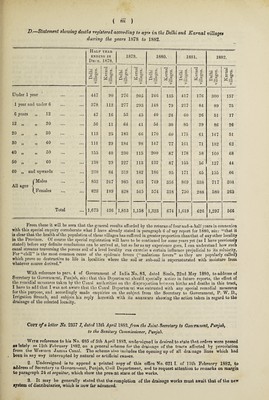
![Proposed Drainage Lines. 24. Para. 12—Drainage Line No. I. is proposed for the purpose of draining the city and station of Karnal and surrouu >i 11 swamps. 1'his project f>»r this line has been received, aud was returned with a note which will enable it c<> be resubmitted with estimate complete.—[In hand ] 25. Drainage Line No II —Mr Oliver proposes two alternative lines from Her, and a third which would leave the kbadir untouched, and which, insteid of having a direct outfall into the Jamna, would throw the drainage water into the jhlls at G- »hana, to he from th -nee conveyed by the enlargement of the cut (No. IV. below) by the II >waun escape channel into the Jamna The first of the alternatives from Ker has, with the exception that thu line does not take no any parts of the deep nallah, been accepted. A proj ct and esti¬ mate have been submit'ed, and returned with a note, from which a complete estimate can be drawn out. Tho cut as now proposed will, to a certain extent, be available as a canal escape. It. will also take uu the drainage water of a considerable area in which the canal is not concerned. The reasons for rejecting the other two alternatives are, that the cut on the line of the proposed Hanipit e-cape will not include the drainage which it was intended t bat the old Her escape should b»ke uu, and as this drain tire has once ''ecu interfered with, it must of necessity be considered in any future scheme. The reasons tor d tiering with Mr Oliver’s advocacy of the Gohana scheme are, that it would entail the enla■•gem ml of an aitificiai cut on a line, which has a very small available slope; t hat the effect of throwing extra water even fora short time into th^ jhils at Grohana cannot he accurately measured, but may he disastrous; and, further, that taking a qu unity of draiuage so far inland only to bring it hack uu another line is au unscientific way of disposing of it.—[Survey made. Estimate returned for correct ion.] 26.. Drainage Line No III.—Comprises the clearance and demare >t on of the old channel of the Nye nallah, takintr the water under the New ll.ansi Branch above Satidon, aud discharging through the jtills at Gohaua into Mam Drain No IV., which is described below ; the marking out aud plans of this drainage are said to be in hand.—[lieport received. Orders will be passed shortly ] 27. Drainage Cut No. IV., which has been allud'd to above in connection with II. and III., is on the line of the o d Bad>diahi Canal from Gohaua to J.itau a on the present Delhi Canal down this line to near Gan eats til i where it passes out througn the present Bowa it escap * head, and under tne aqueduct mi the New Jdelhi Branch to the Jamna. On his sheet 5 Mr. Oliver gives a longitudinal section down the old Badsbahi Canal and part of the Delhi Canal and escape, and shows than there is a slope of only 0 5 per mile available aa far as the sill ol tne Bowaua escape head line Badshd li Canal cross's the cuts from tne Ju-Ji jhil and from Ehateaon, which will thus be intercepted by this cut, No IV., and 1 would propose increasing the slope from the crossing of tne Jiiili drainage, ibis can be done by lowering the crest of the Bowaua escape head in tho old Delhi Canal where there is an over all of some 14 teen. I'ne object of this increase of slope is to put the bed of the cut more within soil, and to lessen its width and cost. From the old escape head to the Jamna tlieie is ample slope. With reference to this cut, His Honor rem irks th>t he considers it the most important of all the lines ol drainage, and that it should receive early attention.—[Cannot be put in band until distribu¬ taries, which are in baud, have been completed ] 2S. Drainage No. V. — Contemplates the removal of obstructions in the G mdah nallah in the TeJnidir below Haul pat, and its connection with the nallah which tails into the .lamna at Khojapur The course of tha nallah ui I have to be straightened in a few places to increase the slope. 'Ibis scheme, Mr Oliver says, would perfectly drain Panipat. This line is outside irrigated limits, and the canal is not concerned in it.—[This is being worked in con¬ nection with Drainage No. II.] 29. Drainage No VI.— Phis drain is also in the Win dir, and h v^rv slightly affected bv canal irrigation and diainage. Mr. Oliver in a separate note on Civil Secretary’s No 1250. dared l^tii November I8S1, which conveyed His Honors remarks on this drainage cut, says that neb>w Sonepat the khddir drainage is influenced by the Bowana escape, aud below Alipur (the head of die B nvaua escape) several <>f the khadir villages are more or less irrigated, 1 may mention that the propos'd tail of No IV. drainage will h • a rectification of ilia alignment and levels of the old B iwana e-cane, and that the drainage of the villages below Alipur will be taken up by ibis tail, -o that with the exception of the east Juili draina.ee which it. is proposed tin tne printed note, page JO) to take into this No. VI. drain near Pitarnpura, No VI. drain wiU b; unaffected by the canal. J t is, as iem irked by His Honor, a long line, but there is no lair outlet for tbe waters higher up than the place where Mr. Oliver has located the tail, and past experience of cuts in t'\e khudir has shown that they must slant actoss and make a very small angle with the course ol ih>* river, or the river floods will hack up and «•! se the month ol the cut with silt. Sir. Oliver proposes to take advantage of'the natural drainages as much as pos* Bible, (the deep channels are all of them near the high bank), md to improve them where very tortuous by short artificial cuts, l’he outfall of the drainage will ho rtt ule in connection with that propos. d for drain No. 1\. aud tile new Bowaua (Daryapur/ escape, aud they will all flow into the river together.—[\ot touched ] 30. Drainage Cut No. VII—Is the continuation of the Judi and Bhatgaon cuts he ow the point where they are intercepted by the main drain, No IV. I gather that nothing more is proposed to be done to these cuts (which were cleared to some extent by His Honor’s orders in 1881) than the usual temoval of obstacles, bo that the water may find its way into the Najafgarh jiiil.—[Completed.] 31. Drainage Cut No. Till—Is the continuation of No. III., which is diverted into TV. ; the work will consist, ol demarcating and, where necessary, clearing the course of the Nye nallah : the drainage ends in. the sand hills below liohlak.—[Not touched ] 32. Drainages Los. IN. and N.—No. IX lies between the Butana and proposed Beri Branches, and runs out into the sand. No X. between the Bi-ri (proposed) Branch and the Ilansi Canal. Nothing beyond demarcation is proposed, and even that seems to be hardly uecessury at present.— [Not touched] -](https://iiif.wellcomecollection.org/image/b3148928x_0206.jp2/full/800%2C/0/default.jpg)