[Report 1909] / Medical Officer of Health, Salop / Shropshire County Council.
- Shropshire (England). County Council.
- Date:
- 1909
Licence: Attribution 4.0 International (CC BY 4.0)
Credit: [Report 1909] / Medical Officer of Health, Salop / Shropshire County Council. Source: Wellcome Collection.
13/148 (page 9)
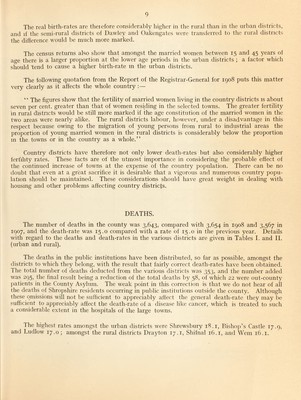
![The real birth-rates are theiefore considerably higher in the rural than in the nrl)an districts, and if the seini-niral districts of Dawley and Oakengates were transferred to the rural districts the difference would be much more marked. The census returns also show that amongst the married women between 15 and 45 years of age there is a larger ])roportion at the lower age periods in the urban districts ; a factor which should tend to cause a higher birth-rate m the urban districts. The following quotation from the Report of the Registrar-General for igo8 puts this matter very clearly as it affects the whole country :— “ The figures show that the fertility of married women living in the country districts is about seven per cent, greater than that of women residing in the selected towns. The greater fertility in rural districts would be still more marked if the age constitution of the married women in the two areas were nearly alike. The rural districts labour, however, under a disadvantage in this respect because owing to the migration of young persons from rural to industrial areas the proportion of young married women in the rural districts is considerably below the proportion m the towns or in the country as a whole.” Country districts have therefore not only lower death-rates but also considerably higher fertility rates. These facts are of the utmost importance in considering the probable effect of the continued increase of towns at the expense of the country population. There can be no doubt that even at a great sacrifice it is desirable that a vigorous and numerous country popu¬ lation should be maintained. These considerations should have great weight in dealing with housing and other problems affecting country districts. DEATHS. The number of deaths in the county was 3,643, compared with 3,654 in 1908 and 3,567 in 1907, and the death-rate was 15.0 compared with a rate of 15.0 in the previous year. Details with regard to the deaths and death-rates in the various districts are given in Tables I. and II. (urban and rural). The deaths in the public institutions have been distributed, so far as possible, amongst the districts to which they belong, M'ith the result that fairly correct death-rates have been obtained. The total number of deaths deducted from the various districts was 353, and the number added was 295, the final result being a reduction of the total deaths by 58, of which 22 were out-county jiatients in the County Asylum. The weak point in this correction is that we do not hear of all the deaths of Shropshire residents occurring in public institutions outside the county. Although these omissions will not be sufficient to appreciably affect the general death-rate they may be sufficient to appreciably affect the death-rate of a disease like cancer, which is treated to such a considerable extent in the hospitals of the large towns. The highest rates amongst the urban districts were Shrewsbury 18. i. Bishop’s Castle 17.9, and Ludlow 17.0 ; amongst the rural districts Drayton 17.i, Shifnal 16.i, and Wem 16.i.](https://iiif.wellcomecollection.org/image/b30086498_0013.jp2/full/800%2C/0/default.jpg)