[Report 1909] / Medical Officer of Health, Salop / Shropshire County Council.
- Shropshire Council
- Date:
- 1909
Licence: Attribution 4.0 International (CC BY 4.0)
Credit: [Report 1909] / Medical Officer of Health, Salop / Shropshire County Council. Source: Wellcome Collection.
45/148 (page 29)
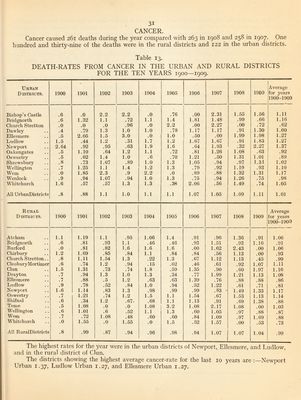
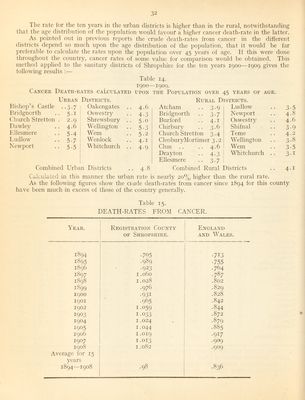
![(4) Arrangements should be made for the disinfection of the house or those j)arts in which the patient has lived. Broadly speaking, the walls, floors, and furniture should he washed with a disinfectant, all washable clothing should be stcc])cd in the disinfectant, and all other clothing, carpets, curtains, bedding, etc., should be disinfected in a steam disinfector. Chloride of lime (li 02. to one gallon of water) is a chea]) disinfectant, and has been shown by Prof. Delepine to be very effective. (5) Periodic visits should be made in order to see that the instructions with regard to the disposal of sputum, cleanliness of the house, and other matters are carried out, and to discover removals. It should be the aim of the inspector to see that complete washing of the floors and skirtings is carried out every week, and cleansing of the walls with dough every three months. (6) Disinfection of the house should be carried out after removal or death of the patient. (7) Visits should be paid to the workshop where the ])atient is employed to see that there is no spitting on the floor and that the place is clean. Great care must in these cases be taken not to disclose the reason for the visit. Similar \-isits should be made to other places resorted to by the patient, e.g., public houses. (8) Great attention should be paid to remedying insanitary conditions of houses, etc., associated with phthisical cases. The work of sanitary authorities with regard to the more advanced cases of phthisis is one of the utmost importance, and one which is likely to be lost sight of, unless insisted upon. It is these cases that give off such a large amount of infectious material and that constitute the real danger. During the early part of this more advanced and incurable stage the patient is in many cases able to go about his work much as usual, and he is able, ij properly instructed- and trained, to so dispose of his sputum and control infection given off by coughing that there is little or no danger. At a still later stage the problem is different. The following quotation from Koch vividly describes the state of things that now exists :—“ The last three or four weeks of life are the most deadly in the spread of infection. The man dies at last, but the education in him dies before him ; his every cough, sneeze, or effort of speech sends lorth a spray laden with bacilli in virulent form, deadly to the poor wife and children around.” The work of a sanitary authority should be devoted to improving the isolation so as to lessen the risk of infection to the rest of the household. Those persons who are in receipt of Poor Law medical relief might with advantage be removed to special wards in the Workhouse Infirmaries. For other persons there is the alternative of improving isolation at home, so as to provide a separate sleeping room, kept under conditions that will not favour the spread of infection and improving the methods adopted for preventing infection so as to give reasonable safety ; or removal to a cottage or hospital provided specially for this purpose. So far no provision of this kind has been made in any part of the County, and it is worth considering whether the hospitals provided for small-pox might not he used for this purpose. They would he kept in greater readiness than they are at present, and in the event of an outbreak of small-pox they could he emptied at once. One of the most important matters in the prevention of consumption is early recognition of the disease. The County Council helps materially in this matter by the provision of facilities for the examination of sputum, and these facilities might be used to a greater extent with advan¬ tage. The medical inspection of school children is bringing to light cases in the earliest stage, many of which would otherwise have been overlooked until too advanced for cure. The notifi¬ cation of consumption will give opportunity for discovering incij)ient secondary cases in the same household. The provision of a sanatorium will, by making the treatment of phthisis more hopeful, undoubtedly remove some of the obstacles that at present exist to an earlv and definite diagnosis of the disease. The educational work of the Association will s])read a knowledge of the importance of early diagnosis and of the early symptoms of ])hthisis.. All these influences will lead to the more early recognition of the disease, ancl it remains to be seen whether there is scope in any part of the County for the work of a tuberculosis dis})ensary.](https://iiif.wellcomecollection.org/image/b30086498_0045.jp2/full/800%2C/0/default.jpg)