[Report 1909] / Medical Officer of Health, Salop / Shropshire County Council.
- Shropshire Council
- Date:
- 1909
Licence: Attribution 4.0 International (CC BY 4.0)
Credit: [Report 1909] / Medical Officer of Health, Salop / Shropshire County Council. Source: Wellcome Collection.
72/148 (page 52)
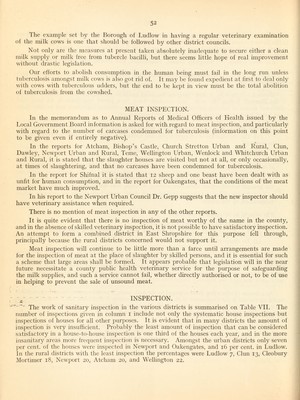
![The example set by the Borough of Ludlow in having a regular veterinary examination of the milk cows is one that should be followed by other district councils. Not only are the measures at present taken absolutely inadequate to secure either a clean milk supply or milk free from tubercle bacilli, but there seems little hope of real improvement without drastic legislation. Our efforts to abolish consumption in the human being must fail in the long run unless tuberculosis amongst milk cows is also got rid of. It may be found expedient at first to deal only with cows with tuberculous udders, but the end to be kept in view must be the total abolition of tuberculosis from the cowshed. MEAT INSPECTION. In the memorandum as to Annual Reports of Medical Officers of Health issued by the Local Government Board information is asked for with regard to meat inspection, and particularly with regard to the number of carcases condemned for tuberculosis (information on this point to be given even if entirely negative). In the reports for Atcham, Bishop’s Castle, Church Stretton Urban and Rural, Clun, Dawley, Newport Urban and Rural, Teme, Wellington Urban, Wenlock and MTiitchurch Urban and Rural, it is stated that the slaughter houses are visited but not at all, or only occasionally, at times of slaughtering, and that no carcases have been condemned for tuberculosis. In the report for Shifnal it is stated that 12 sheep and one beast have been dealt with as unfit for human consumption, and in the report for Oakengates, that the conditions of the meat market have much improved. In his report to the Newport Urban Council Dr. Gepp suggests that the new inspector should have veterinary assistance when required. There is no mention of meat inspection in any of the other reports. It is quite evident that there is no inspection of meat worthy of the name in the county, and in the absence of skilled veterinary inspection, it is not possible to have satisfactory inspection. An attempt to form a combined district in East Shropshire for this purpose fell through, principally because the rural districts concerned would not support it. Meat inspection will continue to be little more than a farce until arrangements are made for the inspection of meat at the place of slaughter by skilled persons, and it is essential for such a scheme that large areas shall be formed. It appears probable that legislation will in the near future necessitate a county public health veterinary service for the purpose of safeguarding the milk supplies, and such a service cannot fail, whether directly authorised or not, to be of use in helping to prevent the sale of unsound meat. - -- ' - - - - INSPECTION. * ^ work of sanitary inspection in the various districts is summarised on Talde VIE The number of inspections given in column i include not only the systematic house inspections but inspections of houses for all other jmrjioses. It is evident that in many districts the amount of inspection is very insufficient. Probably the least amount of inspection that can be considered satisfactory in a house-to-house inspection is one third of the houses each year, and in the more insanitary areas more frequent insj^ection is necessary. Amongst the urban districts only seven ]ier cent, of the houses were ins])ccted in Newj)ort and Oakengates, and 16 per cent, in Ludlow. In the rural districts with the least inspection the percentages were Ludlow 7, Clun 13, Cleobury Mortimer 18, Ncw])ort 20, Atcham 20, and Wellington 22.](https://iiif.wellcomecollection.org/image/b30086498_0072.jp2/full/800%2C/0/default.jpg)