[Report 1909] / Medical Officer of Health, Salop / Shropshire County Council.
- Shropshire Council
- Date:
- 1909
Licence: Attribution 4.0 International (CC BY 4.0)
Credit: [Report 1909] / Medical Officer of Health, Salop / Shropshire County Council. Source: Wellcome Collection.
76/148 (page 54)
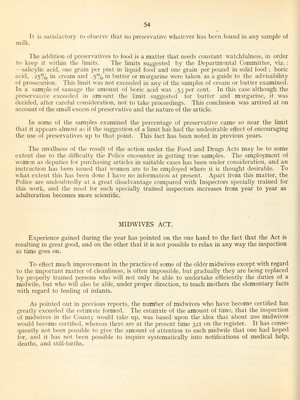
![It is satisfactory to observe that no preservative whatever has been found in any sample of milk. J he addition of preservatives to food is a matter that needs constant watchfulness, in order to kee]) it within the limits. The limits suggested by the Departmental Committee, viz. : —salicylic acid, one grain per pint in liquid food and one grain per pound in solid food ; boric acid, .25% in cream and .5% in butter or margarine were taken as a guide to the advisability of prosecution. This limit was not exceeded m any of the samples of cream or l)utter examined. In a sample of sausage the amount of boric acid was .53 per cent. In this case although the jtreservaiive exceeded in amount the limit suggested for butter and margarine, it w'as decided, after careful consideration, not to take proceedings. This conclusion was arrived at on account of the small excess of preservative and the nature of the article. In some of the samples examined the percentage of preservative came so near the limit that it appears almost as if the suggestion of a limit has had the undesirable effect of encouraging the use of j)reservatives up to that point. This fact has been noted in previous years. The smallness of the result of the action under the Food and Drugs Acts may be to some extent due to the difficulty the Police encounter in getting true samples. The employment of women as deputies for purchasing articles in suitable cases has been under consideration, and an instruction has been issued that women are to be employed where it is thought desirable. To what extent this has been done I have no information at present. Apart from this matter, the Police are undoubtedly at a great disadvantage compared with Inspectors specially trained for this work, and the need for such specially trained inspectors increases from year to year as adulteration becomes more scientihe. MIDWIVES ACT. Experience gained during the year has pointed on the one hand to the fact that the Act is resulting in great good, and on the other that it is not possible to relax in any way the inspection as time goes on. To effect much improvement in the practice of some of the older midwives except with regard to the important matter of cleanliness, is often impossible, but gradually they are being replaced by properly trained persons who will not only be able to undertake efficiently the duties of a midwife, but who will also be able, under proper direction, to teach mothers the elementary facts with regard to feeding of infants. As pointed out in previous reports, the number of midwives who have become certified has greatly exceeded the estimate formed. The estimate of the amount of time, that the inspection of midwives in the County w'ould take up, was based upon the idea that about 200 midwives would become certified, whereas there are at the present time 321 on the register. It has conse¬ quently not l)een possible to give the amount of attention to each midwife that one had hoped for, and it has not been })ossible to inquire systematically into notifications of medical help, deaths, and still-births.](https://iiif.wellcomecollection.org/image/b30086498_0076.jp2/full/800%2C/0/default.jpg)