[Report 1909] / Medical Officer of Health, Salop / Shropshire County Council.
- Shropshire Council
- Date:
- 1909
Licence: Attribution 4.0 International (CC BY 4.0)
Credit: [Report 1909] / Medical Officer of Health, Salop / Shropshire County Council. Source: Wellcome Collection.
78/148 (page 56)
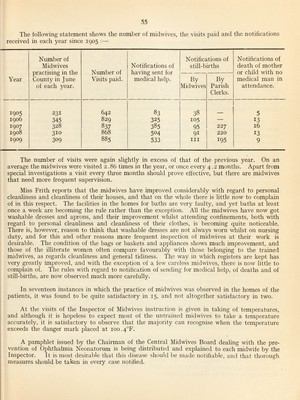
![The inspection of midwives is already an important means of S])reading knowledge of the principles that apply to the feeding and care of infants. This is made a subject of i)ersonal instruction by the inspector on her visits, and leaflets specially drawn u]) for the purpose are given to the midwife for her to leave with and exjdain to the mothers. There is evidence, that both the midwives and the mothers they attend, are interested in this teaching, and are deriving beneht but in the majority of cases the methods of hand feeding employed are still radically wrong. It is encouraging however to know that the experience of the inspector jjoints to the fact that in the country districts the majority of children are fed on the breast for a longer or shorter period. In my report to the Education Committee I have emphasized the extreme importance of correct methods of feeding of infants and young children in encouraging correct habits of mastication and bringing about proper development of the teeth and jaws. This is a matter in which Educa¬ tional and Sanitary Authorities should join forces. Notifications of sending for Medical Help.—Reference to the preceding table shows that the number of notifications received is steadily increasing. This increase no doubt indicates a greater conformity to the rule enforcing notification to the Local Supervising Authority, and also what is of much greater importance it indicates that midwives are realising the necessity for sending for medical help when there is any abnormality. This is the only true basis upon which the practice of midwifery by nurse midwives can be founded, for if midwives are allowed to attend cases in which there is abnormality or disease, an infeiior order of medical practitioners is sanctioned with great detriment to the public. On the other hand nothing but good can result from having a sufficient supply of women trained in the best methods of managing a normal labour and able to detect sufficiently early, deviations from normal requiring medical assistance. It is obvious that one of the most important duties imposed upon Local Supervising Authorities is to see that medical help is sent for in accordance with the rules, and for this purpose it is necessary that all the formalities should be strictly adhered to. The Local Supervising Authority is now taking a much more serious view of non-compliance with the rules in this respect. It is very probable that many failures to send for medical help never come under our notice, and the only remedy that one can suggest is the provision for more frequent inspection and for more special investigations. It is very satisfactory to be able to record that in most districts the difficulties in the way of obtaining medical help for poor women in emergencies have been considerably lessened by the action of the Boards of Guardians. Notifications of Still-births. ■ The rule making it compulsory for a midwife to notify any still-birth she may attend is an important one, and although it has not been possible so far as a routine practice, to make inquiries into these cases, the possibility of inquiry is a considerable safeguard. In order to obtain an independent return of still-births as a check, the parish clerks and the cemetery authorities have been asked to supply me with particulars of still-born children who are in future buried in their burial grounds. All the cemetery authorities, with two excep¬ tions, and practically all the parish clerks or the clergy acting for them, have very kindly under¬ taken to supply me with this information, and my thanks are due to them- The notifications thus received have been a considerable help in carrying out the Act. In previous reports I have stated that a systematic inquiry into all still-births occurring in the practice of midwives would throw light upon many matters, and amongst others it would enable one to estimate the frequency of the various causes of still-birth. The causes of still-births may be grouped for our puqmses into two classes, (i) those operating before labour commences, (2) those operating during the birth of the child. It is particularly in the latter class of cases that lives may be saved by skilled attention.](https://iiif.wellcomecollection.org/image/b30086498_0078.jp2/full/800%2C/0/default.jpg)