Bubonic plague. : Memorandum on the treatment of patients in their own homes and in local hospitals / presented to both Houses of Parliament by command of Her Majesty.
- Hong Kong
- Date:
- 1903
Licence: In copyright
Credit: Bubonic plague. : Memorandum on the treatment of patients in their own homes and in local hospitals / presented to both Houses of Parliament by command of Her Majesty. Source: Wellcome Collection.
Provider: This material has been provided by London School of Hygiene & Tropical Medicine Library & Archives Service. The original may be consulted at London School of Hygiene & Tropical Medicine Library & Archives Service.
46/48 page 46
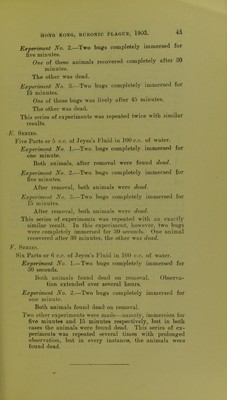
![Minute by His Excellency the Governor. This auywera the question as to possible continuance of virulence of the J3. 'pestis in human beings over a dormant season, but I am afraid that I did not convey my meaning correctly to the Principal Civil Medical Officer. What I should- like to see subjected to bacteriological exami- nation is, not simply whether the B. pestis will survive, and lunv long; 1 want to know, or rather I suggest to l)r. Hunter that it would be valuable to Science to kno.w, the condfuct of a culture over a whole period of a year. Given a culture iu a large quantity of agar-agar—so large a quantity that the bacillus has the most ample opportunity of propagation continuously—will the B. pestis continue to pro- pagate uninterruptedly, the conditions being favourable, or will it, as would a vegetable seed, lie dormant for a time and the>n at the recurring period of the year again actively propagate? (.2) It will be equally valuable to know, whether during the dormant time—if there be, as I assume, a dormant time—the B. pestis is virulent. All this would be determined in one year. ])r. Hunter will know from the books if such an experiment has been tried, but I should prefer one experiment made now by Dr. Hunter to any published account. I do not forget that at the meeting of medical men at Government House, authority was quoted for the statement that the B. pestis was rarely found; in the blood save immediately before death. Yet Doctors Atkinson, Thomson and Bell knew from experience that this is not so. Two other lines of investigation I would suggest if they have not already been entered upon. (1) Has the breath of a patient suffering from pneumonic plague been thoroughly examined for B. pestis? (2) Has the sudor of a plague patient been so examined, and if so, with what result? The first question is important from the point of view of contagion, the second' as bearing upon the general infection of clothing. H. A, B. 31-8-03. ' , - . I vy L... W](https://iiif.wellcomecollection.org/image/b24916511_0048.jp2/full/800%2C/0/default.jpg)


 No text description is available for this image
 No text description is available for this image
 No text description is available for this image