Licence: Public Domain Mark
Credit: On digestive proteolysis. Source: Wellcome Collection.
Provider: This material has been provided by the Augustus C. Long Health Sciences Library at Columbia University and Columbia University Libraries/Information Services, through the Medical Heritage Library. The original may be consulted at the the Augustus C. Long Health Sciences Library at Columbia University and Columbia University.
33/164 page 13
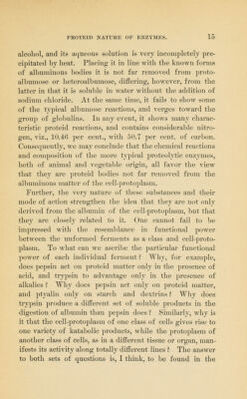
![closely related to the albumoses. Tliey are soluble in water and more or less soluble in glycerin ; at least glycerin will dissolve them from moist tissues, or from moist pre- cipitates containing them. Langley/ however, states, and perhaps justly, that we have no positive proof that either ferments or zymogens are soluble in pure strong glycerin, and that if they are soluble, it is extremely slowly. In dilute glycerin, however, these ferments dissolve readily, as we very well know. Furthermore, they are practically non-diffusible, and, like many albumoses, are precipitated in part by saturation with sodium chloride and completely on saturation with ammonium sulphate. When dissolved in water and heated above 80° C, these enzymes are decom]30sed to such an extent that their pro- teolytic power is totally destroyed. The amount of coagu- lum produced by heat, however, is comparatively small, though variable with different preparations. Thus with trypsin, Kiihne originally considered that boiling an aque- ous solution of the ferment would give rise to about twenty per cent, of coagulated proteid and eighty per cent, of peptone-like matter. With the purer preparations now obtainable there is apparently less coagulable matter present, and Loew ^ has succeeded in preparing from the pancreas of the ox a sample of trypsin containing 52.75 per cent, of carbon and 16.55 per cent, of nitrogen, and yield- ing only a small coagulum by heat. Loew considered the ferment to be a true peptone, but in view of our present knowledge regarding the albumoses, I think we are justi- fied in assuming it to be an albumose-like body rather than a true peptone. At the same time it may be well to again emphasize the fact that our only means of determining ' Gamgee's Physiological Chemistry of the Animal Body, vol. 2, p. 4. 1893. ^ Ueber die chem.ische Natur der ungeformten Fermente. Pfliiger's Archiv f. Physiol., Band 27, p. 203.](https://iiif.wellcomecollection.org/image/b21226003_0033.jp2/full/800%2C/0/default.jpg)

 No text description is available for this image
 No text description is available for this image
 No text description is available for this image