Report of Royal Commission upon the Administration and Operation of the Contagious Diseases Acts.
- Great Britain. Royal Commission on the Contagious Diseases Acts
- Date:
- 1871
Licence: Public Domain Mark
Credit: Report of Royal Commission upon the Administration and Operation of the Contagious Diseases Acts. Source: Wellcome Collection.
Provider: This material has been provided by London School of Hygiene & Tropical Medicine Library & Archives Service. The original may be consulted at London School of Hygiene & Tropical Medicine Library & Archives Service.
787/952 page 689
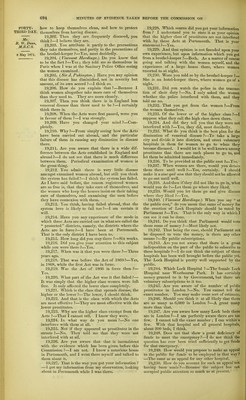
![19.057. Well, the boys are ?—The boys have com- mitted a crime against the law. 19.058. There you draw the line ?—You could not send a boy to a reformatory because you thought he was going to do something, but on the evidence of a poh'cemau that a girl was going to tempt to prostitu- tion you would send her to prison. I should certainly object to that. 19.059. I will refer to that again presently, but will now call your attention to a paragraph in this report, in which it is said,* All these measures, to some extent conflicting with the ordinary rights of individuals, have been successively sanctioned by the Court of Cassation, which in France is the supreme authority in legislation. Do not you therefore consider that the police regulations have the same authority in France with respect to prostitution that the Act has in England ?—The Court of Cassation is the chief court of appeal. I am not sure how the matter was put, but one can conceive an appeal being made to the court, and the appeal not being granted, without its necessarily presupposing a legislative Act to have taken place. 19.060. All these measures have been successively sanctioned by the Court of Cassation, therefore the Court of Cassation, being the highest court of all, has given its sanction to them ?—No, has refused to interfere. 19.061. The statement in this book is that all these measures have been successively sanctioned by the Court of Cassation which in France is the supreme authority of legislation. You take the term succes- sively because appeals have been made. You do not think that the regulations have been made and ap- proved of by the Court of Cassation ?—The court does not make regulations. 19.062. Before any police regulations are made in this kingdom here they are sent up to the courts to be sanctioned ?—I think it would not go beyond the prefect of police in Paris, but I am not sure. This is quite a legal question, and I have always understood that the Court of Cassation is always a court of appeal. 19.063. I will leave that. Now here is the way in which a prostitute is taken up by the French police. To warrant her treatment as a prostitute there must be a combination of circumstances, such as the proof of former offences, public notoriety, and other forms of conclusive evidence. That is the method which is resorted to in Paris. Then this is the Act of Parlia- ment : Where an information on oath is laid before a justice by a superintendent of police charging to the effect that the informant has good cause to believe that a woman therein named is a common prostitute. I Avish to know whether you see any difference between those measures?—On what autho- rity do you say there must be a combination of circumstances ? 19.064. So it is stated in the report to Parliament? —I can only say that I am not satisfied with those circumstances. I know the people have been, and I have given you an instance in which an English lady was attempted to be arrested as a prostitute ; but the police, in point of fact, do certain things which I do not think are done in England, and 1 do not think would be tolerated in England. 19.065. {Dr. Bridges.) I think I understood that you are of opinion that there is very great difficulty in the detection of venereal disease generally of all kinds ? —^Not of all kinds. In my own practice at the hospital for diseases of the throat I of course see every day from a dozen to 20 cases of venereal disease with certain symptoms appearing in the throat which are very easy of detection compared with some things. 19.066. But taking first gonoi'rhcea, I understood you to say that is very often a disease very difficult of detection in women ?—Always. 19.067. You would say that invariably it was an exceedingly difiicult thing in the case of a woman who comes to you with a purulent discharge from the vagina to say whether that was gonorrhoea or not ?— * Venereal Committee Report, App. p. 1, 26937. Yes ; I should say that the question of diagnosis FORTY- between actual gonorrhoea and any other vaginal dis- THIRD DAY. charge is a difiicult one under all circumstances. lam —— aware that certain points have been laid down as diag- ^- ^'f*- nostic, and I have observed them in practice myself, ^ but I repeat that it is a very difiicult (juestion, and ^ay^8/1. one is often glad to avail one's self of the character of the individual patient to aid one in the diagnosis. 19.068. Do you consider it important to make the diagnosis ?—So far as the operation under such Acts as this Commission is inquiring into go, I should think it the most important thing that one could do. 19.069. I mean as far as regards primary treatment of patients in private practice, do you consider it an important matter to form a definite opinion in your own mind as to its being gonorrhoea ?—Yes, I consider it important under all circumstances to find out exactly what is the matter with my patients. 19.070. And in what proportion of cases of gonor- rhoea would you say you had failed to make a distinct diagnosis ?—Individually ? 19.071. Yes. Taking, for instance, a hundred cases of gonorrhoea in women that come before you, in what proportion should you say you would fail to make a distinct diagnosis ?—I say this, in private practice one would come to a conclusion, and a tolerably clear conclusion, as a rule, but when j'ou come to inspect a woman for the express purpose of accusing her of being a prostitute, and seeing whether there is gonorrhoea or not, I say it is ini[)ossible to decide, but in private practice there are many other circumstances, and in fact one would almost say of some patients that we know it. 19.072. Now let us come to syphilis. You would, I supi)0se, say it was of very great importance to arrive at a diagnosis as to whether a certain disease was syphilis or not —important, I mean, to the j^ractical treatment of the case ?—Yes. 19.073. In cases that come before you in private practice, are there a very large proportion out of a hundred such cases in which you tire in doubt ?—Y'es, there are a considerable number in which you are in doubt at first ; that is, that there is considerable diffi- culty, and you will very often be able at a later period to be certain, whereas on the fiist interview with your patients you could not be certain. 19.074. Probably in two-thirds of the cases you would perhaps be certain even at first ?—The propor- tion involves a question of one's own skill to a certain extent, and also experience ; one might be more assured on this point, and more experienced than another. 19.075. But a medical man whom you would con- sider a competent practitioner dealing with cases that come before him in the out-patient department of a public hospital, supposing lie has time to examine them, such a competent medical man would form a distinct opinion out of the hundreds of cases which pass before him as to whether they were syphilis or not. Now in what proportion of cases should yon think you Avould be wrong, giving a rough opinion ; do you think you would be wrong iu one-third of the cases ?— I could not say statistically. I could tell you I con- stantly have cases that come to me aftc-r they have been treated for other diseases at general hospitals, and after examining them carefully I have arrived at a conclusion, not unfrequently, perhaps several cases every week, in which I should think the diseases have not been thoroughly diagnosticated. 19.076. You mean very often it happens that the opinion of one of the first observers is that it is a case of some other disease, and it ultimately turns out to be syphilis ?—Yes. 19.077. The error is likely to be made on that side ? —Veiy frequently. 19.078. Is it in your judgment made as frequently the other way, that very often it is thought to be syphilis, and turns out to be something else ?—Yes. ] see great numbers of cases that are apparently at first sight syphilis, but they are not generally local cases, 4 S](https://iiif.wellcomecollection.org/image/b21365945_0787.jp2/full/800%2C/0/default.jpg)