Report of Royal Commission upon the Administration and Operation of the Contagious Diseases Acts.
- Great Britain. Royal Commission on the Contagious Diseases Acts
- Date:
- 1871
Licence: Public Domain Mark
Credit: Report of Royal Commission upon the Administration and Operation of the Contagious Diseases Acts. Source: Wellcome Collection.
Provider: This material has been provided by London School of Hygiene & Tropical Medicine Library & Archives Service. The original may be consulted at London School of Hygiene & Tropical Medicine Library & Archives Service.
814/952 page 716
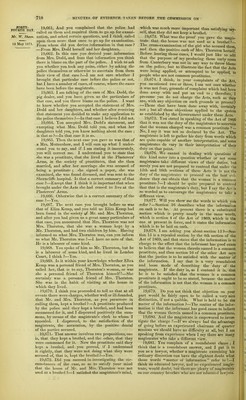
![Fm?TV- divorce, the fact that adultery alone is sufficient to FOURTH DAY. enable a man to get a divorce, but is not sufficient for a Mr W Sh woman, also tends to keep up the false idea that the law ''■ ' of chastity is different betAveen the sexes. I may be 12 May 1871. allowed to add that from what I have heard, I believe —* there has been a feeling already expressed by the Commission against herding the women together in the examination room. That I feel, from what I have seen, is an exceedingly degrading thing. Women in large numbers, and of very various degrees of degra- dation, being got together in one room, and waiting at the examination rooms to be sent in one after another, knowing the j)urpose for Avhich they are going, and employing the time Avhich elapses before they go in, in the sort of liorrible talk that goes on there, tends to level tlie Avhole doAvnwards ; and if any examination of any kind is to be provided, the surgeons should lie made really visiting surgeons, and the)'' should sec the Avomcn separately. 19.617. {Sir IV. James.) Do j'ou mean that the surgeons should go to the Avomen's homes ?—At all CA'cnts they ought to see them separately. That is the great object I think, because herding the Avomen together in a waiting room has a very degrading effect upon them. 19.618. {Canon Gregory.) About the difference between the Act of 1864 and the Act of 1866, your objections Avould not be quite so strong against the Act of 1864 as against the Act of 1866, I presume ?— Not quite, certainly, because most of the objections to the mode in Avhich the Acts are put into operation arise upon the compulsory clauses. 19.619. Has your attention ever been draAvn to the great difference of the examination in its relation to the disease of the persons examined under the Act of 1864 and the Act of 1866 ?—No, it has not. I paid no attention to the system until the Act of 1866 called my attention to it ; and of course Avhat I saAV was the system then in operation, 19.620. The points I Avanted to call your attention to are these, that Avhereas under the earlier Act in 1864 there Avcre 1,027 examined altogether, of Avhom 783 were found to be diseased, tliere the system obvioiasly was simply to find a diseased person ?—Yes. 19.621. But in the later Acts, out of 52,000 exami- nations, there were 4,000 found to be diseased. Would not you draAV a broad distinction betAveeu persons examined, the gi'eat majority of Avhom were diseased, and persons examined periodically, a small minority of Avhom Avere diseased ?—I think there is a very con- siderable distinction; but of course my objection Avould remain to any examination Avhere there is no disease. Examination to cure disease Ave must of course accept. 19.622. I presume you Avould not object to detention of a Avoman knoAvn to be diseased until she was cured ? —I think that depends very much on the truth of the allegations Avhich have been made on both sides as to Avhether or not they are Avilling to remain in hospital. As far as I can judge, the experience especially of the A^oluntary hospital at Bristol, Avhich has been esta- blished of late years, shoAvs that there would be no difficulty at all; in fact, that the Avomen are anxious, especially the lower class of prostitutes, to have the opportunity of entering into a well-conducted hospital when they are diseased, rather than remain on the streets, and that there is no difficulty in inducing them, in fact they do not want inducing, to remain there until they are cured. 19.623. Still you are ahvays aware that there is a considerable per-centage of Avomen Avho, fi'oni temper, or from other causes, constantly Avant to leave?—I think it is a choice of evils. I think there are enor- mous moral evils arising from turning the hospitals into prisons. Compulsory detention is turning a hospital into a prison, and you make your doctors and nurses gaolers. 19.624. {Sir W. James.) Have you ever turned your attention to the A^ery superior accommodation there is for dissolute women and their diseases in Avork- houses ?—I think there is more accommodation there than there is in ordinary hospitals. 19.625. Have you ever been into Avhat are called the dissolute AA^ards to see how Avretched and miser- able some of the poor creatures are in some country workhouses ?—I should be A^ej-y glad to see all the Avards made more decent. 19.626. You knoAV the difference between the form of information in the Act of 1864 and the Act of 1866 ? —I have not specially examined the Act of 1864. 19.627. YouAvill observe it is someAvhat important ? ■—I am aAvare of the difference being that under the Act of 1864 the superintendent had to declare his belief that there Avas actual disease, but under the Act of 1866, simply that the woman Avas a prostitute. 19.628. You observe that the Avhole basis of legis- lation in the Act of 1864 is entirely different from Avhat it is in the Act of 1866 —Entirely different. 19.629. Would that obviate in a great measure your objection to the system ?—No, it Avould not. because I do not see the right Ave have in comparing this par- ticular disease and the diseases of the honest ])oor, to iuA^est public money in facilitating prostitution by making fornication more healthy, Avhereas we do nothing Avhatever Avith public money, or comjmratively nothing, for the diseases of the honest hardworking people. 19.630. You would generally then object to any legislation for the diminution of syphilitic disease being paid for by the public ?—Except in so fixr as it was legislation for the diminution of prostitution. I object to attempting to legislate for tlie effect, pass- ing by the cause. All legislation Avhich is Avisely directed to diminishing prostitution I should be very glad to support, but legislation Avhich, accepting pros- titution, simply attempts to prevent one of its effects, I most decidedly object to. 19.631. The latter objection Avould apply to voluntary Lock hospitals ?—No, because I think that is just the distinction. The cure of all disease seems to me to be a perfectly legitimate field for A'oluntary labour. I am entirely in favour of the extension of A'oluntary hospitals. 19.632. Your objection then Avould be to giA-e the GoA^ernment money for the cure of that particidar disease ?—For the cure of that particular disease. 19.633. And not for other diseases?—And not for other diseases. 19.634. {3Ir. Applegarth.) Did I understand you to say that these notices Avhich girls now receiA^e in lieu of the certificate they formerly received, are actually used at Uie present time for the purpose of solicitation in the streets ?—I have no doubt of it at all. I'hey say so, and the moment you see how it reads, it would appear natural that it should be so. 19.635. I think you are connected with the associa- tion Avliich has amongst its objects the prosecution of men Avho have improper intercourse Avith Avomen and children. In the course of your experience have you found many young children have been accosted in the streets by men ?—Yes, a great many in the parks, and in the streets also. 19.636. You think from that that they are led on to prostitution ?—No doubt. Indecency tOAvards a child is almost certain to end in the introduction of that child to the ranks of prostitution. 19.637. In reference to that particular point and many others, you have offered several suggestions. Do I understand you to say that if those suggestions were embodied into law, it would have a tendency to de- crease prostitution ?—I believe it would. 19.638. And therefore to decrease the necessity for legislation in connexion with prostitution in any way whatever ?—I believe it would. At the same time I look for the real diminution of prostitution much more to the raising of the state of civilisation of the class out of which prostitutes come. I think it is impossible to suppose we can much diminish prostitution until the mass of the poorer classes are able to live decent lives in their own homes. 19.639. Would it be your o])inion then, that instead](https://iiif.wellcomecollection.org/image/b21365945_0814.jp2/full/800%2C/0/default.jpg)