Outlines of comparative physiology : touching the structure and development of the races of animals, living and extinct for the use of schools and colleges / by Louis Agassiz and A.A. Gould ; edited from the revised ed. and greatly enl. by Thomas Wright.
- Louis Agassiz
- Date:
- 1855
Licence: Public Domain Mark
Credit: Outlines of comparative physiology : touching the structure and development of the races of animals, living and extinct for the use of schools and colleges / by Louis Agassiz and A.A. Gould ; edited from the revised ed. and greatly enl. by Thomas Wright. Source: Wellcome Collection.
442/480
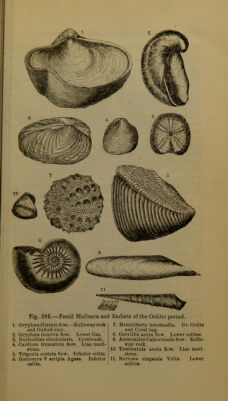
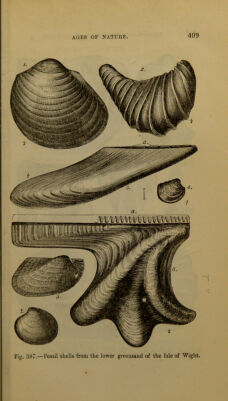
![40S of the family Asterim the genera Stylina, Montlivaltia, Thecosmilia, Rhabdophyllia, Cladophyllia, Goniocora, Isastrea, Thamnastrea; and of the family Fungidje, the genera Como- seris, Protoseris, are found in the Coral-rag of Wiltshire. In the Great Oolite, besides spefcies of many of these genera, others belonging to Cyathophora, Convexastrea, Calamophyllia, Cladophyllia, Clausastrea, occur. Similar coralbeds exist in the limestones belonging to the Inferior Oolite, from -whence the genera Discocyathus, Trochocyathus, Axosmilia, Thecosmilia, Latomeandra, Anabacia, with numerous species belonging to many of the Coral-rag genera, are found. The echinoderms present a great variety of forms. The crinoids are not quite so numerous as in former ages. Among the most abundant is the Pentacrinus. There are also comatula-like animals, that is to say, free crinoids (Pterocoma pinnata). Many star-fishes are likewise found in the various stages of this formation. Finally, there is an extraordinary variety of urchins, among them Cidaris and Hemicidaris (fig. 386, 7) with large spines, and several other types not found before, as, for example, Pygaster, Dysaster and Nucleolites (fig.386, 3).] § 677. The fauna of the Cretaceous period bears the same general characters as the Oolitic, but with a more marked tendency towards existing forms. Thus the Ichthyosauri and Plesiosauri, characterizing the preceding epoch, are suc- ceeded by gigantic lizards, approaching more nearly the rep- tiles of the present day. Among the mollusca, a great num- ber of new forms appear, especially among the cephalopoda, as Ammonites, Crioceras, Scaphites, Ancyloceras, Hamites, Bacidites, Turrilites, some of which resemble the gasteropoda in shape, but are nevertheless chambered. The Ammonites themselves are quite as numerous as in the Oolitic period, and are in general much ornamented. The acephala furnish us also with peculiar types, not found elsewhere, as Magas, Ino- ceramus, Hippurites, and peculiar Spondyli, with long spines. There are also a great variety of gasteropoda, among which some peculiar forms of Pleurotomaria, Rostellaria, and Ptero- ceras, are very characteristic. The radiata are not inferior to the other classes in the novelty and variety of their forms. In figs. 387 and 388, some of the most characteristic fossil shells from.the lower greensand strata are represented.](https://iiif.wellcomecollection.org/image/b28056644_0444.jp2/full/800%2C/0/default.jpg)