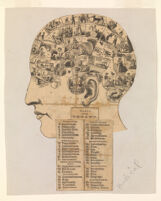
Names of the organs.

Date:
[1846?]
Reference:
27714i
  • Pictures
  • Online

Available online

view Names of the organs.

Contains: 2 images

Public Domain Mark

You can use this work for any purpose without restriction under copyright law. Read more about this licence.

Credit

Names of the organs. Public Domain Mark. Source: Wellcome Collection.
Selected images from this work

View 1 image

About this work

Also known as

Previous title, replaced February 2026: A head divided into thirty seven compartments, each containing an image representing a phrenological faculty. Wood engraving, after O.S. Fowler, c. 1840.

Description

A head divided into thirty seven compartments, each containing an image representing a phrenological faculty.

Publication/Creation

[Boston, Massachusetts] : [1846?]

Physical description

1 print : wood engraving

Lettering

Names of the organs. Domestic group. 1. Amativeness. A. Conjugality. 2. Parental love. 3. Friendship. 4. Inhabitiveness. 5. Continuity ...Selfish propensities. E. Vitativeness. 6. Combativeness. 7. Destructiveness. 8. Alimentativeness. 9. Acquisitiveness. 10. Secretiveness. 11. Cautiousness. Aspiring and governing organs. 12. Approbativeness. 13. Self-Esteem. 14. Firmness. Moral sentiments. 15. Conscientiousness. 16. Hope. 17. Spirituality. 18. Veneration. 19. Benevolence. Perfective qualities. 20. Constructiveness. 21. Ideality. B. Sublimity. 22. Imitation. D. Agreeableness. 23. Mirthfulness. Perceptive faculties. 24. Individuality. 25. Form. 26. Size. 27. Weight. 28. Color. 29. Order. 30. Calculation. 31. Locality. Literary faculties. 32. Eventuality. 33. Time. 34. Tune. 35. Language. Reasoning faculties. 36. Causality. 37. Comparison. C. Human nature

Notes

The phrenological system here enumerated is the Fowler version. Additions to European analogues include: "Alimentativeness", "Vitativeness", "Spirituality", and "Human nature"
The design seems to originate with the Fowlers, a family of popular phrenologists operating in the United States in the last half of the nineteenth century. The plate was used in "Synopsis of phrenology and physiology : comprising a condensed description of the functions of the body and mind..." by L.N.Fowler, published in Boston, 1846.
The engraving has been cut from the original sheet and collaged onto plain paper.
The title has been taken from wording on the object.

Reference

Wellcome Collection 27714i

Exhibitions note

Exhibited in "The Brain in Art & Science" at Bundeskunsthalle, Bonn, Germany, 28 January – 28 June 2022.

Type/Technique

Languages

Where to find it

  • Location Access
    On Exhibition
    Can't be requested

    Note

Permanent link