Volume 1
The history of Our Lord as exemplified in works of art : with that of His types, St. John the Baptist, and other persons of the Old and New Testament / commenced by the late Mrs. Jameson ; continued and completed by Lady Eastlake.
- Anna Brownell Jameson
- Date:
- 1865
Licence: Public Domain Mark
Credit: The history of Our Lord as exemplified in works of art : with that of His types, St. John the Baptist, and other persons of the Old and New Testament / commenced by the late Mrs. Jameson ; continued and completed by Lady Eastlake. Source: Wellcome Collection.
422/444 page 382
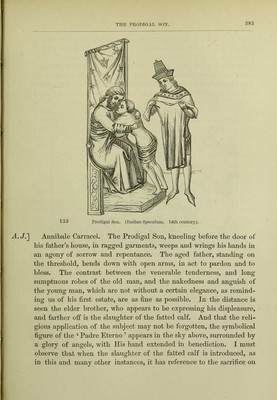
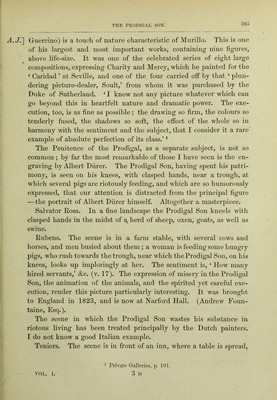
![The Prodigal Son. Hal. II Figlio prodigo. Fr. L’Enfant prodigue. Germ. Der vcrlorene Soliu. We can easily understand how this parable became more popular as a subject of Art than any of the others. As related in the simple words and with the divinely persuasive tenderness of the Eedeemer, it touches every heart. Taken in its mystical sense, it is a lesson of faith and hope; in its more obvious sense, it is a lesson of hope and charity, at once a comfort to the erring and a rebuke to the self-righteous. The moment usually chosen for artistic representation, when the story has to be told in one scene, is the return of the Penitent to the house of his Father, for that certainly is the chief point in the reli- gious moral. This was the incident told in early Christian Art, as embodying the ideas of Eepentance and Forgiveness.] We give this quaint illustration, of the 14th century (No. 135), from Mr. Boxall’s Speculum. It has a tender grace of its own. The youth of the Pro- digal is conspicuous here—he is ^ Fenfant prodigue.’ An attendant stands by, holding the raiment. [A. J,—But sometimes we have the moment of self-abasement, where he is reduced to feeding swine, and perishing of hunger; or, much more rarely, we have the scene in which he is wasting his patrimony in riotous living. Of the first subject, the instances are so numerous, that I can only mention a few of the most remarkable. Its picturesque capabilities in expression, character, and costume, and in the contrast between youth and age, have rendered it a favourite Scriptural piece with the later painters and designers, as its familiar and tender significance, and intelligible grouping, have made it a favourite with the people. We have here Bassano again in great force. It was just one of those subjects in which his genius revelled—homely, natural, strong feeling, with all the accessories of domestic furniture—preparations for a feast, animals, and these painted with an evident gusto, and all glowing with life and colour.](https://iiif.wellcomecollection.org/image/b24876239_0001_0424.jp2/full/800%2C/0/default.jpg)