Surgery : its theory and practice / by William Johnson Walsham.
- William Walsham
- Date:
- 1887
Licence: Public Domain Mark
Credit: Surgery : its theory and practice / by William Johnson Walsham. Source: Wellcome Collection.
Provider: This material has been provided by The University of Leeds Library. The original may be consulted at The University of Leeds Library.
15/772 page 3
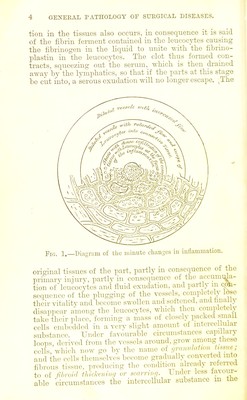
![and leucocj'tes are seen to drop out here and tliere from the central stream, which as you know from your j-ihysio- logical studies, appears yellowish in colour from the red corpuscles being contained in it. These truant leucocytes first roll lazily along in the pale or circumferential current, and are joined by more and more as the blood-stream further slackens in speed. Now they adhere to the walls of the veins, and to a less extent to the walls of the capillaries, so that the vessels appear as if lined with them. Soon they begin to pass through the vessel-walls into the tissues around, a process which need not here be described, as it is one with which }'ou are no doubt already famihar. By and by the coloured corpuscles, in groups of two to a dozen, also leave the central stream and pass through the walls of the vessels into the tissues, j^roducing those patches of darker redness and the mottling of the sur- face alluded to above. The central stream next begins to oscillate, flowing onwards during the systole, and slightly receding dming the diastole of the heart; whiLst the colom-ed corpuscles show a tendency to adhere to one another. Finally the stream stops, and stasis is said to have occiu-red (Fig. 1). In the meantime the liquid contents of the vessels have also been passing through the vessel-walls into the tissues, and this, together with the escaped leucocytes, accounts for the swelling and for the serous exudation which can be squeezed out when the parts arc cut into. The serum, further, soaks into the neighbouring healthy tissues, thus explaining the surrounding oedema, and is thence, along with some of the leucocytes, taken up hy the lymphatics, and so passes back into the circulation, and as we shall presently see, may jinrtly account for the attendant in- flammatory fever. If now the cause of the iullaiumation ceases to act, and the vitality of the tissues has not boon too much lowered to permit of their recovery, the cor- puscles in the middle of the stream in those vessels where stasis has occurred again begin to oscillate and tlieu to move on; the leucocytes no longer droj) out of tlio current, and those that have alrciady oscajuid into tlio tissues either break down or ])ass along with the csi'ajx'd Huids into the lymphatics, leaving the jiart apparently uninjured. If the above favourable tormination does not take place and stasis is not soon relieved, coagulation of the seruna rapidly ensues, and the vessels b(H'omo thrombosed. At the same time, moreover, coagulation of the liipiid cxuda- B 2](https://iiif.wellcomecollection.org/image/b21511159_0015.jp2/full/800%2C/0/default.jpg)
 No text description is available for this image
 No text description is available for this image
 No text description is available for this image