Surgery : its theory and practice / by William Johnson Walsham.
- William Walsham
- Date:
- 1887
Licence: Public Domain Mark
Credit: Surgery : its theory and practice / by William Johnson Walsham. Source: Wellcome Collection.
Provider: This material has been provided by The University of Leeds Library. The original may be consulted at The University of Leeds Library.
71/772 page 59
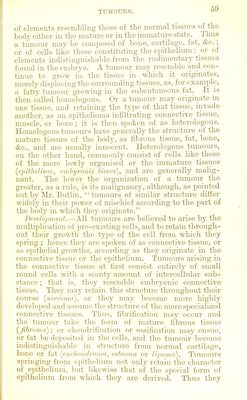
![TUMOURS. of elements resembling those of the normal tissues of the body cither in the matiu-e or in the immatm'e state. Thus a tumour may be composed of bone, cartilage, fat, &c.; or of cells like those constituting the epithelium; or of elements indistinguishable from the rudimentary tissues found in the embryo. A tumoiu- may resemble and con- tinue to grow in the tissue in which it originates, merely displacing the surrounding tissues, as, for example, a fatty tumour growing in the subcirtaneous fat. It is then called homologous. Or a tumour may originate in. one tissue, and retaining the type of that tissue, invade another, as an epithelioma infiltrating connective tissue, muscle, or bone; it is then spoken of as heterologous. Homologous tumours have generallj' the structure of the matiu-e tissues of the bodj^ as fibrous tissue, fat, bone, &c., and are usually innocent. Heterologous timiours, on the other hand, commonly consist of colls like those of the more lowly organised or the immature tissues [epithelium, cmhyronic tissue), and are generally malig- nant. The lower the organization of a tumour the greater, as a rule, is its malignancy, although, as pointed out by Mr. Butlin, tumours of similar structiu'e differ widely in their power of mischief according to the part of the body in which they originate. Development.—All tumours are believed to arise by the multiplication of pre-existing cells, and to retain through- out their growth the type of the cell from which they spring ; hence they are spoken of as connective tissue, or as epithelial growths, according as they originate in the connective tissue or the epithelium. Tiimours arising in the connective tissue at first consist entirely of small round colls with a scanty amount of intercellular sub- stance; ; that is, they resemble cmbrj'onic connective tissue. They may retain this structure throughout their course [sfircoma), or they may become more highly developed and assume the structure of the more sjjecialized connective tissues. Thus, fibriiication may occur and the tumour take the form of mature fibrous tissue [fibrtimd); or chondrification or ossilication may cnsvio, or fat 1)0 d<'])ositi'(l in the cells, and the tumour bcconro indistinguishable in structure from normal cartilage, bone or fat [cnc/iondroina, osteoma or lipoma). Tumoiu's springing from ci)itholiuni not only retain tlie character of epithelium, but likewise that oi' tlio special fornr of epithelium from which they are derived. Thus they](https://iiif.wellcomecollection.org/image/b21511159_0071.jp2/full/800%2C/0/default.jpg)
 No text description is available for this image
 No text description is available for this image
 No text description is available for this image