Surgery : its theory and practice / by William Johnson Walsham.
- William Walsham
- Date:
- 1887
Licence: Public Domain Mark
Credit: Surgery : its theory and practice / by William Johnson Walsham. Source: Wellcome Collection.
Provider: This material has been provided by The University of Leeds Library. The original may be consulted at The University of Leeds Library.
82/772 page 70
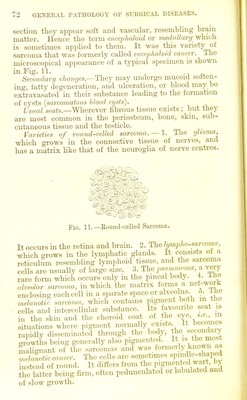
![Signs, diagnosis, and treatment. See Diseases of tlie Breast, Eecturn, &c. C. Tumours of the type of Emlryonic connective tissue (Sarcomata). Sarcomata constitute a group of tumours resembling in structiu'e normal embryonic or immatm-e connective tissue. They include the fibro-nucleated, fibro-plastic, myeloid and recurrent fibroid tumours, and many of the so-called cancers of the older pathologists. Normal em- bryonic tissue in the course of development may become fibrous tissue, cartilage, bone, &c. The sarcomata, how- ever retain the structure of embryonic tissue thi-oughout their life-history; and although in places, and mdeed, m some instances in the gi-eator part of the tumoui-, de- velopment may proceed as in the normal growth of tlie body to the formation of fibrous tissue, cartilage, or bone, yet the circumferential or growing parts of the tumom- will always be found to consist of sarcoma elements. Hence the im]iortance of examining the growing part lest a sarcoma which has undergone chondrification, ossifacation. etc., be pronounced a cartilaginous or osseous tumour The sarcomata present the most diverse characters, both as regards their- structure and tlieir climcal behaA-iour but have the following in common:—!, ihe ceils ot which thcv are composed consist of masses of protoplasm without distinct cell-wall, and contain one. or more nuclei Each cell is surrounded by a varpng amount of inteTCellular substaiico, which has no definite arrange- ment, and does not form alveolar spaces as m camnoimT. 3 The blood-vessels have very thm walls, and ramify among the cells, not in the stroma as m carcinoma ; indeed, they arc often mere s]iacos bounded by the cell^ themselves hence, the fre<iuency -^^'^J^^'f' rhages occur in the substance of the growth. 4 rh-|i nation usually takes ],lace by the blood-vessels (not Vn he ^iphatics, a. in carcinoma), a fact which inav probaW bl explained by the above-mentioned i'^-!'^^^ h^ vessels to the cells. 5. Tlie secondary growths, when dissemination occurs are, as a rule, hke the pnmarv, and st fre.,uent in the lungs. (5. Sarcomata ^'^ow by in- C 1^1 ng the surrounding tissue, and genera ly l]^ after removal, probablv bc<-ause souu- porti.^n ot mhltiatcl](https://iiif.wellcomecollection.org/image/b21511159_0082.jp2/full/800%2C/0/default.jpg)
 No text description is available for this image
 No text description is available for this image
 No text description is available for this image