A voyage to Senegal; or, historical, philosophical, and political memoirs, relative to the discoveries, establishments and commerce of Europeans in the Atlantic Ocean, from Cape Blanco to the River of Sierra Leone. To which is added an account of a journey from Isle St. Louis to Galam / By J.P. [!] L. Durand ... Translated from the French, & embellished with numerous engravings.
- Jean Baptiste Léonard Durand
- Date:
- 1806
Licence: Public Domain Mark
Credit: A voyage to Senegal; or, historical, philosophical, and political memoirs, relative to the discoveries, establishments and commerce of Europeans in the Atlantic Ocean, from Cape Blanco to the River of Sierra Leone. To which is added an account of a journey from Isle St. Louis to Galam / By J.P. [!] L. Durand ... Translated from the French, & embellished with numerous engravings. Source: Wellcome Collection.
15/208 (page 9)
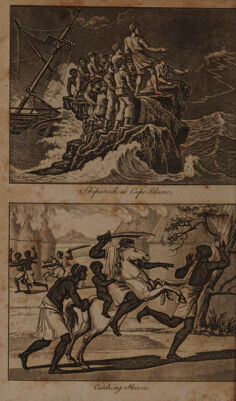
![VOYAGE SENEGAL. CHAP. I. CAPE BLANCO AND ITS ENVIRONS.—DANGERS OF THAT PASSAGE.—BARBAROUS AND CRUEL CHARACTER OF THE MOORS WHO INHABIT THE COAST.—SHIPWRECK OF M. DE BRISSON.—CAPTURE OF HIM AND HIS COM- PANIONS.—CHARACTER OF A MOORISH CHIEF.—HARD- SHIPS OF CAPTIVITY IN THE DESERTS.—LIBERATION ‘OF M. DE BRISSON AND ONE OF HIS COMPANIONS. On reaching the western coast of Africa, navigators meet first with Cape Blanco, which is situated in 20° 55 m. 30sec. lat. and 19° 30m. long. Itis a spot almost circular, insomuch that, on account of its far projections, it is more difficult to discover than any-other point on the coast: it is surrounded with dangerous banks, which are with difficulty avoided; and it derives its name from the white colour of its burning and arid soil. ‘he next point is Cape St. Anne, which is to the eastward: on the same parallel; the distance from one cape to the other, is computed at eight leagues. ‘They form between them a large and deep bay, about twelve leagues north and south, which contains va- rious mouths of torrents or rivers, in which the sea ascends so high as to spoil the fresh water, and thus deprives vessels of the only resource which this part of the coast would otherwise afford them. From Cape St. Anne to Salt Cape, the coast runs S. E. fo about six leagues. This cape received its name from a variety of natural and abundant salt-pits which it contained, and from which, before the rainy season, a quantity of sait used to be col- lected. The Europeans, however, have abandoned them; but it is probable that the Moors turi them to advantage. About six leagues farther; at the point called Hof, is another bay as large and deep as the former: it contains three isles, the largest of which is to the eastward, and is called Arguin. It1s necessary to pass all these capes, in order to arrive at the French posses- DURAND.] R Pres](https://iiif.wellcomecollection.org/image/b22039132_0015.jp2/full/800%2C/0/default.jpg)