Cases relating to the medical council : for the use of members of the General Medical Council only / (edited by Fredk, Willis Farrer.).
- Farrer, Frederick Willis.
- Date:
- 1897
Licence: Public Domain Mark
Credit: Cases relating to the medical council : for the use of members of the General Medical Council only / (edited by Fredk, Willis Farrer.). Source: Wellcome Collection.
Provider: This material has been provided by The University of Leeds Library. The original may be consulted at The University of Leeds Library.
22/86 page 14
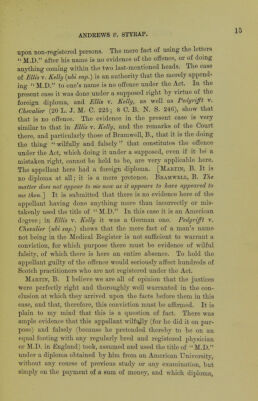
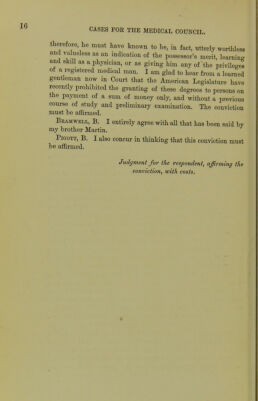
![Upon these facts the justices came to the conclusion that the appellant had committed the offence charged in the information, and they duly convicted him thereof as aforesaid, and the question for this Court is whether, upon the above facts, the justices were justified in coming to that conclusion, and so con- victing the said appellant, or whether the fact of the appellant having obtained the above-mentioned diploma exonerated him from the charge made against him. Sects. 31, 36, and 40 of the Medical Act of 1858 were referred to. Huddleston, Q.C. (with him was Bullen)^ for the respondent, supported the conviction, and following the course adopted in Ellis V. Kelly (3 L. T. Eep. N. S. 331 ; 30 L. J. Ex. 74 and M. C. 35; 6 H. & N. 222) and Jones v. Taylor (28 L. J. M. 0. 20) was called on by the Court to begin. He contended that the conviction was right, and that the justices, having found all the facts and come to a decision upon them, the Court would not interfere with the conclusion at which they had arrived. Ladd V. Gould, 1 L. T. Eep. N. S. 325. R. Vaughan Williams for the appellant, contra, urged that the diploma of the University of Philadelphia, which was an institu- tion of high standing and fully empowered to grant degrees, was a sufiicient warrant for the appellant's use of the title of *' M.D., and saved him from coming within the operation of sect. 40 of the Medical Act. [Pigott, B. The American Uni- versity may be all that you say it is, but unfortunately this student has never been there.] It appears that the University is constantly in the habit of appointing examiners in other countries, and non constat that that was not done here. The fact of the Act of Parliament granting certain privileges to some per- sons and imposing certain restrictions on others, by no means makes it unlawful to practise or to assume the title of M.D. The Act only imposes certain liabilities or restrictions, as for instance, by sect. 36, no unregistered person can hold certain medical oflBces there specified. If it be contended that the mere fact of practising as a doctor without being registered is an offence, the answer is in that section. The offence must be some- thing more ; a man must practise as a doctor with the object of obtaining the privilege conferred by the Act on registered indi- viduals, or of avoiding pr getting rid of the disabilities imposed](https://iiif.wellcomecollection.org/image/b21508124_0022.jp2/full/800%2C/0/default.jpg)