Cases relating to the medical council : for the use of members of the General Medical Council only / (edited by Fredk, Willis Farrer.).
- Farrer, Frederick Willis.
- Date:
- 1897
Licence: Public Domain Mark
Credit: Cases relating to the medical council : for the use of members of the General Medical Council only / (edited by Fredk, Willis Farrer.). Source: Wellcome Collection.
Provider: This material has been provided by The University of Leeds Library. The original may be consulted at The University of Leeds Library.
23/86 page 15
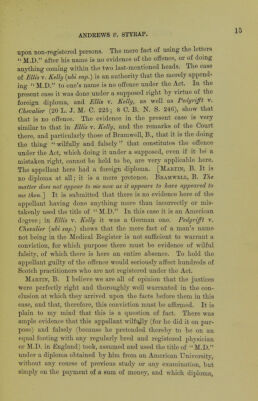
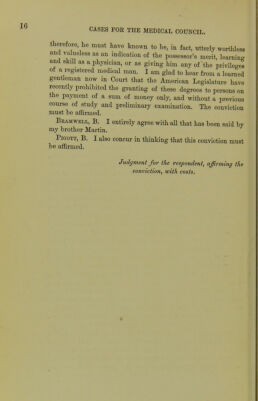
![upon non-registered persons. The mere fact of using tlie letters M.D. after his name is no evidence of tlie offence, or of domg anything coming within the two last-mentioned heads. The case of Ellis V. Kelli/ {uhi sup.) is an authority that the merely append- ing M.D. to one's name is no offence under the Act. In the present case it was done under a supposed right by virtue of the foreign diploma, and Ellis v. Kelly, as well as Pedgrifft v. Chevalier (20 L. J. M. C. 225; 8 0. B. N. S. 246), show that that is no offence. The evidence in the present case is very similar to that in Ellis v. Kelly, and the remarks of the Court there, and particularly those of Bramwell, B., that it is the doing the thing wilfully and falsely that constitutes the offence under the Act, which doing it under a supposed, even if it be a mistaken right, cannot be held to be, are very appKcable here. The appellant here had a foreign diploma. [Martin^ B. It is no diploma at aU; it is a mere pretence. Bramwell, B. The matter does not appear to nie now as it appears to have appeared to me then.'] It is submitted that there is no evidence here of the api^ellant having done anything more than incorrectly or mis- takenly used the title of M.D. In this case it is an American degree; in Ellis v. Kelly it was a German one. Pedgrifft v. Chevalier {uhi sup.) shows that the mere fact of a man's name not being in the Medical Register is not sufficient to warrant a conviction, for which purpose there must be evidence of wilful falsity, of which there is here an entii'e absence. To hold the appellant guilty of the offence would seriously affect hundreds of Scotch practitioners who are not registered under the Act. Martin, B. I believe we are all of opinion that the justices were perfectly right and thoroughly well warranted in the con- clusion at which they arrived upon the facts before them in this case, and that, therefore, this conviction must be affinned. It is plain to my mind that this is a question of fact. There was ample evidence that this appellant wilfi^Qy (for he did it on pur- pose) and falsely (because he i)retended thereby to be on an equal footing with any regularly bred and registered physician or M.D. in England) took, assumed and used the title of M.D. under a diploma obtained by him fi-om an American University, without any course of previous study or any examination, but simply on the pajTuent of a sum of money, and which diploma,](https://iiif.wellcomecollection.org/image/b21508124_0023.jp2/full/800%2C/0/default.jpg)