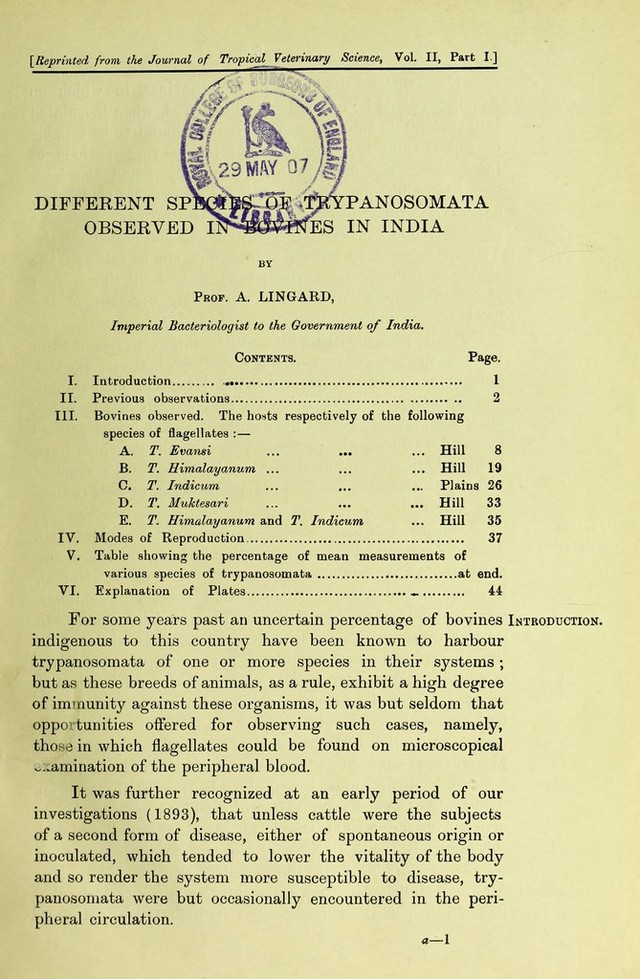
Different species of trypanosomata observed in bovines in India / by A. Lingard.
- Alfred Lingard
- Date:
- 1907
Licence: In copyright
Credit: Different species of trypanosomata observed in bovines in India / by A. Lingard. Source: Wellcome Collection.
Provider: This material has been provided by The Royal College of Surgeons of England. The original may be consulted at The Royal College of Surgeons of England.
27/58 page 23
![This trypanosoma, designated the T. Theileri by Laveran, was met with during the course of immunization of cattle against rinderpest and was found to be very generally dis- tributed. Two forms of parasites were observed, the dis- tinguishing feature being the position of the centrosome. In the ordinary form the centrosoma lies at one end (the posterior) of the body, a considerable distance from the nucleus ; in the other rarer form it is quite near the nucleus, and is occasionally seen attached to it, or lying actually on it. The length varies from 20 to 70^ and the breadth from 2 to 6ij. . The longest are usually found amongst the ordinary forms, the broadest under the rare forms. Laveran, to whom specimens were submitted, considers the trypanosomata of two distinct species and has described them under the names of 2\ Theileri and the rarer one as T. Transvaalensi, but Theiler injected blood containing the rare form and produced the ordinary form, hence this ob- server interprets his results as proving that the trypanosoma is polymorphic. The mode of reproduction of the ordinary form is longitudinal; the proto})lasniic body of the rarer forms appears to have a spherical or oval shape in which posterior and anterior ends are hardly discernible. It is impossible to discover whether such forms represent a longitudinal or a transverse division. Abnormal forms are commonly met with which must be explained either as degenerate or mutilated j^JS-ra-sites seeming to be of very fragile structure. These trypanosomata are only infective for cattle. Mortality, 8 out of 40 inoculated, or 12'5 per cent. The inculjative period varies according to the number of trypano- somata which the infective blood contains, average four to six days ; when 1 c. c. was injected, tlie period was 18 days ; when 50 to 100 c. c., five to six days. The length of time the flagellates are j)resent in the blood varies considerably, and is dependent upon the refractory condition the animal ])resents against the trypanosoma. The longest period was tliirteen days, the average nine days. T1 u'ough tlie kindness of Mr. H. E. Cross, the second Assistant Bacteriologist, wlio lias ])laced at my disjiosal, for examination, several of his microscopiccil specimens of blood](https://iiif.wellcomecollection.org/image/b22463525_0031.jp2/full/800%2C/0/default.jpg)


 No text description is available for this image
 No text description is available for this image
 No text description is available for this image