Licence: Public Domain Mark
Credit: State hygiene. Source: Wellcome Collection.
Provider: This material has been provided by London School of Hygiene & Tropical Medicine Library & Archives Service. The original may be consulted at London School of Hygiene & Tropical Medicine Library & Archives Service.
46/268 page 46
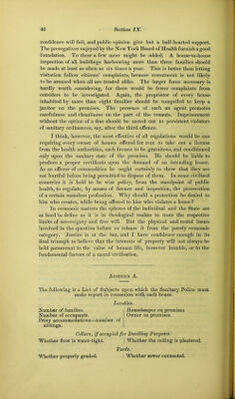
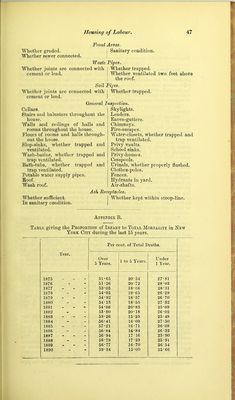
![confidence will fail, and public opinion give but a half-hearted support. The prerogatives enjoyed by the New York Board of Health furnish a good foundation. To these a few more might be added. A house-to-house inspection of all buildings harbouring more than three families should be made at least as often as six times a year. This is better than letting visitation follow citizens’ complaints, because resentment is not likely to be aroused when all are treated alike. The larger force necessary is hardly worth considering, for there would be fewer complaints from outsiders to be investigated. Again, the proprietor of every house inhabited by more than eight families should be compelled to keep a janitor on the premises. The presence of such an agent promotes carefulness and cleanliness on the part of the tenants. Imprisonment without the option of a fine shoiild be meted out to persistent violators of sanitary ordinances, say, after the third offence. I think, however, the most effective of all regulations would be one requiring every owner of houses offered for rent to take out a license from the health authorities, such licence to be gratuitous, and conditioned only upon the sanitary state of the premises. He should be liable to produce a proper certificate upon the demand of an intending lessee. As an offerer of commodities he ought certainly to show that they are not hurtful before being permitted to dispose of them. In some civilised countries it is held to be wise policy, from the standpoint of public health, to regulate, by means of licence and inspection, the prosecution of a certain nameless profession. Why should a protection be denied to him who creates, while being offered to him who violates a home ? In economic matters the spheres of the individual and the State are as hard to define as it is in theological realms to trace the respective limits of sovereignty and free will. But the physical and moral issues involved in the question before us release it from the purely economic category. Justice is at the bar, and I have confidence enough in its final triumph to believe that the interests of property will not always be held paramount to the value of human life, however humble, or to the fundamental factors of a moral civilisation. Appendix A. The following is a List of Subjects upon which the Sanitary Police must make report in connexion with each house. Location. Number of families. Housekeeper on premises Number of occupants. Owner on premises. Privy accommodations—number of sittings. Cellars, if occupied for Dwelling Purposes. Whether floor is water-tight. ] Whether the ceiling is plastered. Yards. I Whether sewer connected. Whether properly graded.](https://iiif.wellcomecollection.org/image/b28045476_0048.jp2/full/800%2C/0/default.jpg)