Licence: Public Domain Mark
Credit: Syllabus of lectures on physiology / by Allen Thomson. Source: Wellcome Collection.
Provider: This material has been provided by the Royal College of Physicians of Edinburgh. The original may be consulted at the Royal College of Physicians of Edinburgh.
7/62 (page 3)
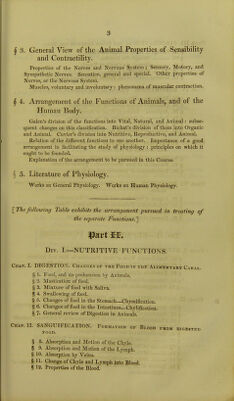
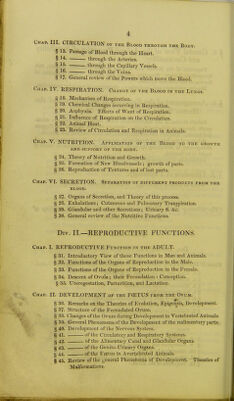
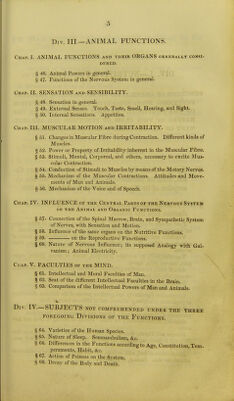
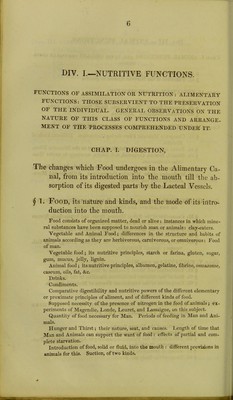
![§ 3. General View of the Animal Properties of Sensibility and Contractility. Properties of the Nerves and Nervous System ; Sensory, Motory, and Sympathetic Nerves. Sensation, general and special. Other properties of Nerves, or the Nervous System. Muscles, voluntary and involuntary: phenomena of muscular contraction. § 4. Arrangement of the Functions of Animals, and of the Human Body. Galen’s division of the functions into Vital, Natural, and Animal: subse- quent changes on this classification. Bichat’s division of them into Organic and Animal. Cuvier’s division into Nutritive, Reproductive, and Animal. Relation of the different functions to one another. Importance of a good arrangement in facilitating the study of physiology : principles on which it ought to be founded. Explanation of the arrangement to be pursued in this Course. § 5. Literature of Physiology. Works on General Physiology. Works on Human Physiology. \The following Table exhibits the arrangement pursued in treating of the separate Functions.~] Div. I.—NUTRITIVE FUNCTIONS. Chap. I. DIGESTION. Changes of theFoodinthe Alimentary Canal. § 1. Food, and its prehension by Animals. § 2. Mastication of food. § 3. Mixture of food with Saliva. § 4. Swallowing of food. § 5. Changes of food in the Stomach—Chymification. § 6. Changes of food in the Intestines—Chylification. § 7* General review of Digestion in Animals. Chap. II. SANGUIFICATION. Fo.hat.ok op B,.ood prom FOOD. § 8. Absorption and Motion of the Chyle. § 9. Absorption and Motion of the Lymph. § 10. Absorption by Veins. § 11. Change of Chyle and Lymph into Blood. § 12. Properties of the Blood.](https://iiif.wellcomecollection.org/image/b21979571_0009.jp2/full/800%2C/0/default.jpg)