The constituents of the rhizome and roots of caulophyllum thalictroides / by Frederick B. Power and Arthur H. Salway.
- Frederick Belding Power
- Date:
- [1912?]
Licence: Public Domain Mark
Credit: The constituents of the rhizome and roots of caulophyllum thalictroides / by Frederick B. Power and Arthur H. Salway. Source: Wellcome Collection.
3/24
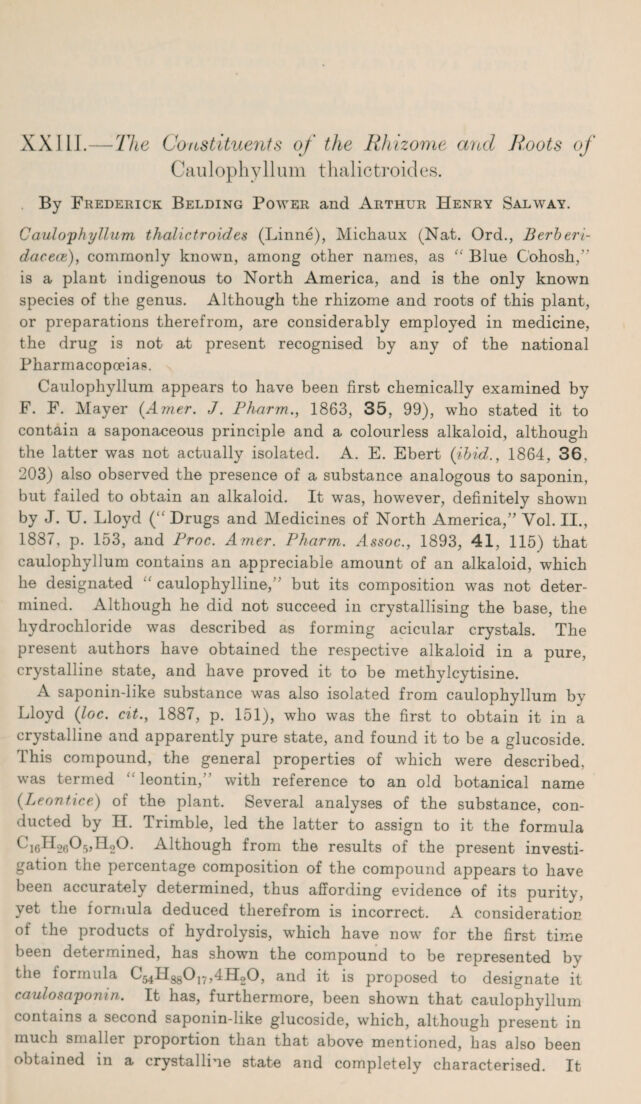
![XXIII.—The Constituents of the Rhizome and Roots of Caulophyllum thalictroides. By Frederick Belding Power and Arthur Henry Sal way. Caulophyllum thalictroides (Linne), Michaux (Nat. Ord., Berberi- dcicece), commonly known, among other names, as “ Blue Cohosh/’ is a plant indigenous to North America, and is the only known species of the genus. Although the rhizome and roots of this plant, or preparations therefrom, are considerably employed in medicine, the drug is not at present recognised by any of the national Pharmacopoeias. Caulophyllum appears to have been first chemically examined by F. F. Mayer {Amcr. J. Pharm., 1863, 35, 99), who stated it to contain a saponaceous principle and a colourless alkaloid, although the latter was not actually isolated. A. E. Ebert {ibid., 1864, 36, 203) also observed the presence of a substance analogous to saponin, but failed to obtain an alkaloid. It was, however, definitely shown by J. U. Lloyd (“ Drugs and Medicines of North America/’ Vol. II., 1887, p. 153, and Proc. Amer. Pharm. Assoc., 1893, 41, 115) that caulophyllum contains an appreciable amount of an alkaloid, which he designated “ caulophylline,” but its composition was not deter¬ mined. Although he did not succeed in crystallising the base, the hydrochloride was described as forming acicular crystals. The present authors have obtained the respective alkaloid in a pure, crystalline state, and have proved it to be methylcytisine. A saponin-like substance was also isolated from caulophyllum by Lloyd {loc. cit., 1887, p. 151), who was the first to obtain it in a crystalline and apparently pure state, and found it to be a glucoside. This compound, the general properties of which were described, was termed ' leontin,” with reference to an old botanical name (Leontice) of the plant. Several analyses of the substance, con¬ ducted by H. Trimble, led the latter to assign to it the formula ^16^-26^5? S20. Although from the results of the present investi¬ gation the percentage composition of the compound appears to have been accurately determined, thus affording evidence of its purity, yet the formula deduced therefrom is incorrect. A consideration of the products of hydrolysis, which have now for the first time been determined, has shown the compound to be represented by the formula C54H8g0]7,4H20, and it is proposed to designate it caulosaponin. It has, furthermore, been shown that caulophyllum contains a second saponin-like glucoside, which, although present in much smaller proportion than that above mentioned, has also been obtained in a crystalline state and completely characterised. It](https://iiif.wellcomecollection.org/image/b30619567_0003.jp2/full/800%2C/0/default.jpg)