Definitions of R & D : report with evidence.
- Great Britain. Parliament. House of Lords. Science and Technology Committee.
- Date:
- 1990
Licence: Open Government Licence
Credit: Definitions of R & D : report with evidence. Source: Wellcome Collection.
46/148 (page 44)
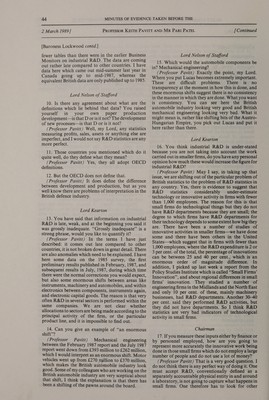
![2 March 1989] [Continued [Baroness Lockwood contd.] fewer tables than there were in the earlier Business Monitors on industrial R&D. The data are coming out rather late compared to other countries. I have data here which came out mid-summer last year in Canada going up to mid-1987, whereas the equivalent British data are only published up to 1985. Lord Nelson of Stafford 10. Is there any agreement about what are the definitions which lie behind that data? You raised yourself in your own _ paper production development—s that D or is it not? The development of new processes—is that D or is it not? (Professor Pavitt) Well, my Lord, any statistics measuring profits, sales, assets or anything else are imperfect, and I would not say R&D statistics are any more perfect. 11. Those countries you mentioned which do it quite well, do they define what they mean? (Professor Pavitt) Yes, they all adopt OECD definitions. 12. But the OECD does not define that. (Professor Pavitt) It does define the difference between development and production, but as you well know there are problems of interpretation in the British defence industry. Lord Kearton 13. You have said that information on industrial R&D is late, weak, and at the beginning you said it was grossly inadequate. ‘““Grossly inadequate”’ is a streng phrase, would you like to quantify it? (Professor Pavitt) In the terms I have just described: it comes out late compared to other countries, it is not broken down in great detail. There are also anomalies which need to be explained. I have here some data on the 1985 survey, the first preliminary results published in February, 1987, and subsequent results in July, 1987, during which time there were the normal corrections you would expect, but also some enormous shifts between areas like instruments, machinery and automobiles, and within electronics between components, instruments again, and electronic capital goods. The reason is that very often R&D in several sectors is performed within the same companies. We are not clear whether allocations to sectors are being made according to the principal activity of the firm, or the particular product line, and it is impossible to find out. 14. Can you give an example of “‘an enormous shift’’? (Professor Pavitt) Mechanical engineering between the February 1987 report and the July 1987 report went down from £393 million to £262 million, which I would interpret as an enormous shift. Motor vehicles went up from £270 million to £370 million, which makes the British automobile industry look good. Some of my colleagues who are working on the British automobile industry are very sceptical about that shift, I think the explanation is that there has been a shifting of the pawns around the board. Lord Nelson of Stafford 15. Which would the automobile components be in? Mechanical engineering? (Professor Pavitt) Exactly the point, my Lord. Where you put Lucas becomes extremely important. These are difficult problems. There is no transparency at the moment in how this is done, and these enormous shifts suggest there is no consistency in the manner in which they are done. What you want is consistency. You can see here the British automobile industry looking very good and British mechanical engineering looking very bad. What it might mean is, rather like shifting bits of the Austro- Hungarian Empire, you pick out Lucas and put it here rather than there. Lord Kearton 16. You think industrial R&D is under-stated because you are not taking into account the work carried out in smaller firms, do you have any personal opinion how much these would increase the figure for industrial R&D? (Professor Pavitt) May I say, in taking up that issue, we are shifting out of the particular problem of British statistics to the problem of R&D statistics in any country. Yes, there is evidence to suggest that R&D _ statistics considerably under-estimate technology or innovative activity in firms with fewer than 1,000 employees. The reason for this is that small firms do technological things but they do not have R&D departments because they are small; the degree to which firms have R&D departments for their technology depends to some extent how big they are. There have been a number of studies of innovative activities in smaller firms—we have done some and there have been others in the United States—which suggest that in firms with fewer than 1,000 employees, where the R&D expenditure is 2 or 3 per cent. of the total, the percentage of innovations can be between 25 and 40 per cent., which is an enormous order of magnitude difference. In addition, I picked up last week a report from the Policy Studies Institute which is called “Small Firms’ Innovation’, and about regional differences in small firms’ innovation. They studied a number of engineering firms in the Midlands and the North East and only 10 per cent. of these, mainly machinery businesses, had R&D departments. Another 30-40 per cent. said they performed R&D activities, but they did not have departments. So I think R&D statistics are very bad indicators of technological activity in small firms. Chairman 17. If you measure these inputs either by finance or by personnel employed, how are you going to represent more accurately the innovative work being done in those small firms which do not employ a large number of people and do not use a lot of money? (Professor Pavitt) That is a very good question. I do not think there is any perfect way of doing it. One must accept R&D, conventionally defined as a separately accountable physical entity in and around a laboratory, is not going to capture what happens in small firms. One therefore has to look for other](https://iiif.wellcomecollection.org/image/b32218540_0046.jp2/full/800%2C/0/default.jpg)