Definitions of R & D : report with evidence.
- Great Britain. Parliament. House of Lords. Science and Technology Committee.
- Date:
- 1990
Licence: Open Government Licence
Credit: Definitions of R & D : report with evidence. Source: Wellcome Collection.
59/148 (page 57)
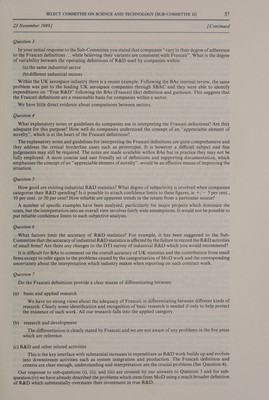
![23 November 1989] [Continued Question 3 In your initial response to the Sub-Committee you stated that companies “‘vary in their degree of adherence to the Frascati definitions... while believing their variants are consistent with Frascati’. What is the degree of variability between the operating definitions of R&D used by companies within: (a) the same industrial sector (b) different industrial sectors Within the UK aerospace industry there is a recent example. Following the BAe internal review, the same problem was put to the leading UK aerospace companies through SBAC and they were able to identify expenditures on “True R&D” following the BAe (Frascati like) definition and guidance. This suggests that the Frascati definitions are a reasonable basis for companies within a sector. We have little direct evidence about comparisons between sectors. Question 4 What explanatory notes or guidelines do companies use in interpreting the Frascati definitions? Are they adequate for this purpose? How well do companies understand the concept of an ‘“‘appreciable element of novelty’’, which is at the heart of the Frascati definitions? The explanatory notes and guidelines for interpreting the Frascati definitions are quite comprehensive and they address the critical borderline cases such as prototypes. It is however a difficult subject and fine judgements may still be required. The notes are made available within BAe but in practice they may not be fully employed. A more concise and user friendly set of definitions and supporting documentation, which emphasises the concept of an “‘appreciable element of novelty”, would be an effective means of improving the situation. Question 5 How good are existing industrial R&D statistics? What degree of subjectivity is involved when companies categorise their R&D spending? Is it possible to attach confidence limits to these figures, ie + /— 5 per cent., 10 per cent. or 20 per cent? How reliable are apparent trends in the return from a particular source? A number of specific examples have been analysed, particularly for major projects which dominate the costs, but the interpretation into an overall view involves fairly wide assumptions. It would not be possible to put reliable confidence limits to such subjective analysis. Question 6 What factors limit the accuracy of R&D statistics? For example, it has been suggested to the Sub- Committee that the accuracy of industrial R&D statistics is affected by the failure to record the R&D activities of small firms? Are there any changes to the DTI survey of industrial R&D which you would recommend? It is difficult for BAe to comment on the overall accuracy of UK statistics and the contribution from small firms except to refer again to the problems caused by the categorisation of MoD work and the corresponding uncertainty about the interpretation which industry makes when reporting on such contract work. Question 7 Do the Frascati definitions provide a clear means of differentiating between: (a) basic and applied research We have no strong views about the adequacy of Frascati in differentiating between different kinds of research. Clearly some identification and recognition of basic research is needed if only to help protect the existence of such work. All our research falls into the applied category. (b) research and development The differentiation is clearly stated by Frascati and we are not aware of any problems in the five areas which are reference. (c) R&D and other related activities This is the key interface with substantial increases in expenditure as R&D work builds up and evolves into downstream activities such as system integration and production. The Frascati definition and criteria are clear enough, understanding and interpretation are the crucial problems (See Question 4). Our response to sub-questions (i), (ii), and (iii) are covered by our answers to Question 3 and for sub- question (iv) we have already described the problems which stem from MoD using a much broader definition of R&D which substantially overstates their investment in true R&D.](https://iiif.wellcomecollection.org/image/b32218540_0059.jp2/full/800%2C/0/default.jpg)