The diseases of children's teeth, their prevention and treatment : a manual for medical practitioners and students.
- Pedley, R. Denison (Richard Denison), 1857-1925.
- Date:
- 1895
Licence: Public Domain Mark
Credit: The diseases of children's teeth, their prevention and treatment : a manual for medical practitioners and students. Source: Wellcome Collection.
Provider: This material has been provided by the University of Toronto, Harry A Abbott Dentistry Library, through the Medical Heritage Library. The original may be consulted at the Harry A Abbott Dentistry Library, University of Toronto.
264/290 page 246
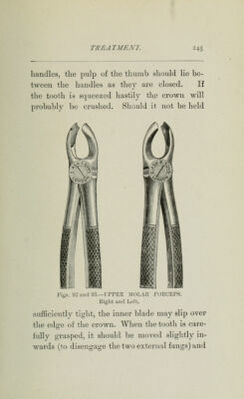
![then steadily, and firmly, outwards and down- wards, the external p]ate of the alveolus giving way. It is very necessary for the practitioner to determine beforehand whether tlie molar he proposes to remove belongs to the temporary or permanent dentition. Temporary molars often require a great deal of force to extract them owing to their divergent fangs; but a permanent molar requires much more force, and the older the patient is, the firmer will be the alveolus round the fangs. Fracture through the crown or neck of a tooth, may, and often does, occur, however careful the attempt to extract, or however skil- ful the operator may be As already mentioned, this will happen if the blades of the instrument are not pushed up far enough to secure a sound portion of the neck. Often it is tlie result of a sudden movement, either on the part of the patient or the operator. The removal of a tooth causes an agony of pain, and not the least painful is the first part of the procedure, due to the necessary pressure of the blades of the forceps in order to secure a sufficient hold of the tooth. The patient will probabl}''](https://iiif.wellcomecollection.org/image/b21202904_0264.jp2/full/800%2C/0/default.jpg)